<?xml version="1.0" encoding="utf-8"?>
<feed xmlns="http://www.w3.org/2005/Atom" xmlns:media="http://search.yahoo.com/mrss/">
    <title>Blog - Public Speaking Coach: Babli</title>
    <link href="https://publicspeakingcoach.app/blog/feed.xml" rel="self" />
    <link href="https://publicspeakingcoach.app/blog" />
    <updated>2025-08-21T12:01:11+02:00</updated>
    <author>
        <name>Public Speaking Coach: Babli</name>
    </author>
    <id>https://publicspeakingcoach.app/blog</id>

    <entry>
        <title>How to Speak on Virtual Calls: 5 Tips for Confident Zoom Presentations</title>
        <author>
            <name>Public Speaking Coach: Babli</name>
        </author>
        <link href="https://publicspeakingcoach.app/blog/how-to-speak-on-virtual-calls-5-tips-for-confident-zoom-presentations.html"/>
        <id>https://publicspeakingcoach.app/blog/how-to-speak-on-virtual-calls-5-tips-for-confident-zoom-presentations.html</id>
        <media:content url="https://publicspeakingcoach.app/blog/media/posts/15/virtual-call-cover.jpg" medium="image" />

        <updated>2025-08-21T11:18:21+02:00</updated>
            <summary>
                <![CDATA[
                        <img src="https://publicspeakingcoach.app/blog/media/posts/15/virtual-call-cover.jpg" alt="Woman in a checked blazer smiling while speaking on a virtual video call on her laptop in a modern workspace with wooden tables and a whiteboard in the background." />
                    Virtual calls are now a standard part of professional life. Whether you are leading a meeting, interviewing, or pitching to clients, how you speak on screen directly shapes how people see your confidence and credibility. The challenge is that virtual speaking is different from being&hellip;
                ]]>
            </summary>
        <content type="html">
            <![CDATA[
                    <p><img src="https://publicspeakingcoach.app/blog/media/posts/15/virtual-call-cover.jpg" class="type:primaryImage" alt="Woman in a checked blazer smiling while speaking on a virtual video call on her laptop in a modern workspace with wooden tables and a whiteboard in the background." /></p>
                <p data-start="213" data-end="435"><strong>Virtual calls</strong> are now a standard part of professional life. Whether you are leading a meeting, interviewing, or pitching to clients, how you speak on screen directly shapes how people see your confidence and credibility.</p>
<p data-start="437" data-end="771">The challenge is that virtual speaking is different from being in a room. You miss natural audience reactions, face technical distractions, and often end up talking too fast. With the right strategies, you can adapt and come across as clear, confident, and engaging. Here are five tips to help you shine on Zoom and other platforms.</p>
<hr data-start="773" data-end="776">
<h2 data-start="778" data-end="810">1. Prepare Your Environment</h2>
<p data-start="812" data-end="1036">Your setup shapes impressions before you say a word. Poor lighting, muffled audio, or a messy background can distract your audience before you even get to your message. The environment should never compete with your words.</p>
<p data-start="1038" data-end="1348"><strong data-start="1038" data-end="1046">Tip:</strong> Face natural light or use a lamp, use a quality mic or earbuds, and keep your background simple. A clean, well-lit setup makes you instantly more credible. If you use a virtual background, avoid busy or unrealistic ones that look cheap. A subtle blur usually works better and keeps the focus on you.</p>
<hr data-start="1350" data-end="1353">
<h2 data-start="1355" data-end="1395">2. Make Eye Contact with the Camera</h2>
<p data-start="1397" data-end="1647">On Zoom, connection comes through the webcam. Looking only at the faces on your screen makes it seem like you are avoiding eye contact. While it may feel unnatural, learning to treat the camera as your audience helps you build trust and engagement.</p>
<p data-start="1649" data-end="1896"><strong data-start="1649" data-end="1657">Tip:</strong> Position the video window near your camera so your gaze is close to the lens, and glance up often. For your key points, look directly into the lens. This small adjustment makes your delivery feel personal and directed to every listener.</p>
<hr data-start="1898" data-end="1901">
<h2 data-start="1903" data-end="1942">3. Use Pauses to Control Your Pace</h2>
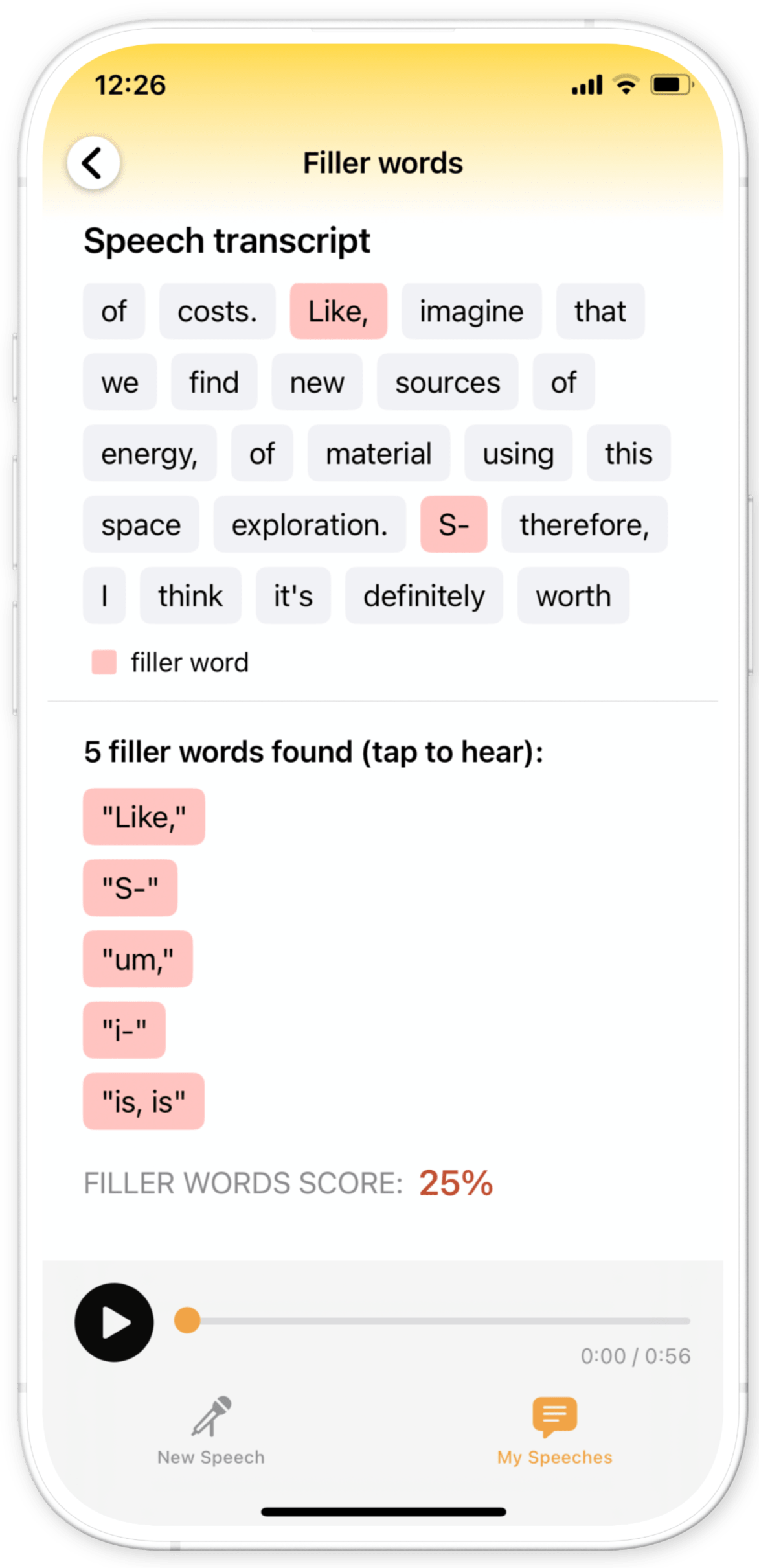
<p data-start="1944" data-end="2260">Many people rush on virtual calls to avoid silence, but this often makes you sound nervous and increases filler words like “um” or “you know.” A well-placed pause creates space for your message to land and shows confidence. It also prevents you from running out of breath mid-sentence, which can weaken your voice.</p>
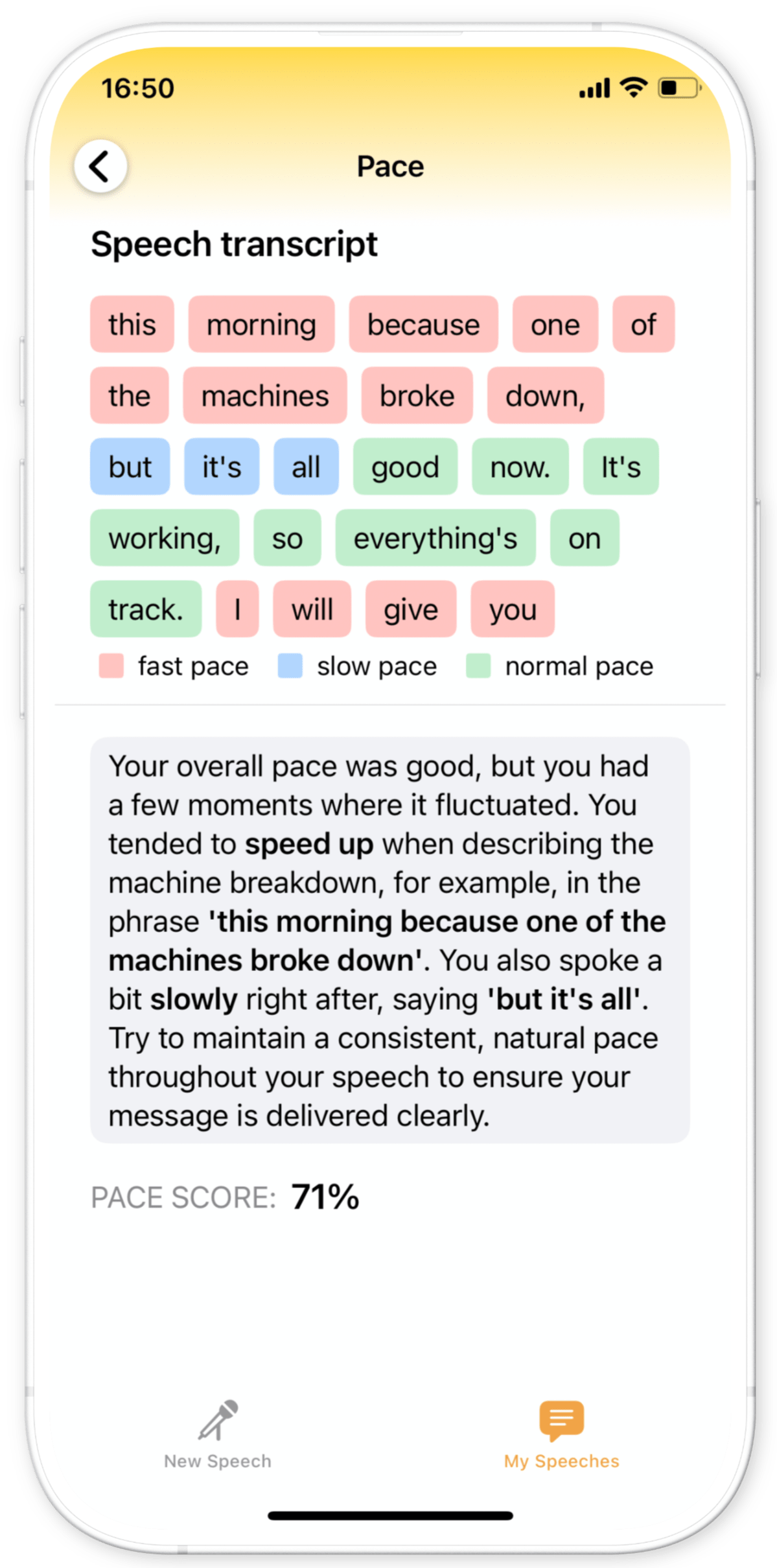
<p data-start="2262" data-end="2558"><strong data-start="2262" data-end="2270">Tip:</strong> Pause for two to three seconds after key points, then continue. Replace fillers with silence and let the moment breathe. If pacing is tough, see our guide on <a href="https://publicspeakingcoach.app/blog/why-you-speak-too-fast-and-how-to-fix-it.html" target="_blank" rel="noopener noreferrer">Why You Speak Too Fast (and How to Fix It)</a>.</p>
<hr data-start="2560" data-end="2563">
<h2 data-start="2565" data-end="2604">4. Keep Your Body Language Engaged</h2>
<p data-start="2606" data-end="2920">Even on camera, your body language communicates as much as your words. Slouching or sitting too far from the screen makes you appear disengaged, while leaning in slightly and using open gestures shows confidence. People also notice micro-expressions. A frown or blank look can change how your words are received.</p>
<p data-start="2922" data-end="3192"><strong data-start="2922" data-end="2930">Tip:</strong> Sit upright, lean in slightly, and keep hands visible to emphasize points. Smile when appropriate and nod occasionally to show you are listening. Avoid crossing arms, slouching, or staring off-screen, all of which can make you appear distracted or unprepared.</p>
<hr data-start="3194" data-end="3197">
<h2 data-start="3199" data-end="3238">5. Practice in a Realistic Setting</h2>
<p data-start="3240" data-end="3497">Confidence grows with exposure to the real conditions you will face. Reading from notes or rehearsing in silence does not prepare you for the unique pressures of a live call. To truly improve, you need to simulate the environment where performance counts.</p>
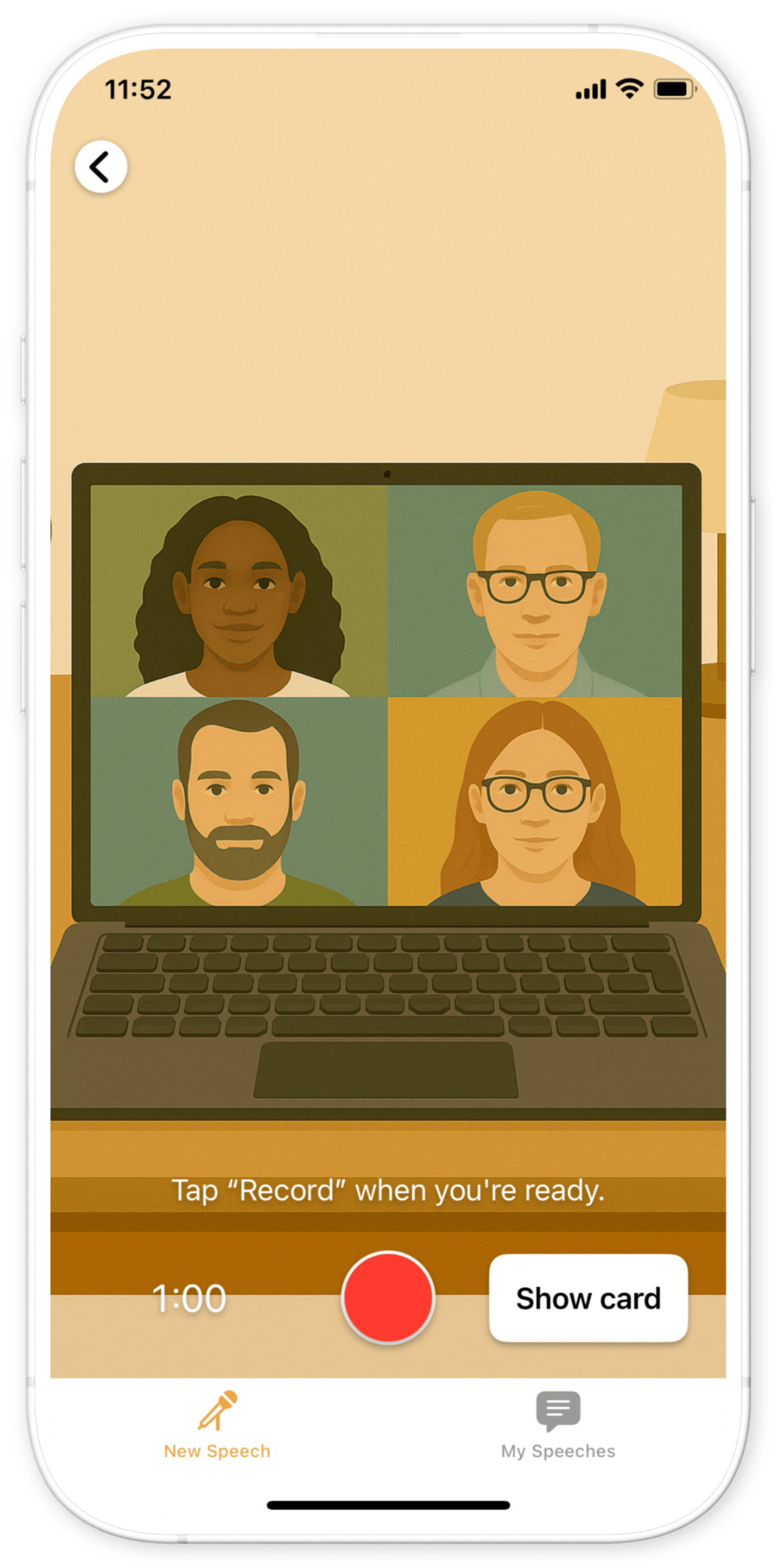
<p data-start="3499" data-end="4064"><strong data-start="3499" data-end="3507">Tip:</strong> Rehearse on Zoom with a friend or colleague to replicate the experience. Record yourself to notice habits you might overlook, such as speaking too quickly or drifting off-camera. Tools like <strong data-start="3698" data-end="3707"><a href="https://apps.apple.com/us/app/public-speaking-coach-babli/id6746377369" target="_blank" rel="noopener noreferrer">Babli</a></strong> let you practice in simulated virtual meetings of all kinds. You can try scenarios as a team leader addressing colleagues, as a CEO presenting strategy, or as a candidate answering tough interview questions. Babli gives you detailed feedback on content, pace, filler words, and delivery so the real call feels like a repeat performance instead of a test.</p>
<figure ><figure class="post__image post__image--left"><img loading="lazy"  src="https://publicspeakingcoach.app/blog/media/posts/15/virtual_call_babli-2.png" alt="Screenshot from Babli app showing a virtual call practice scenario." width="1206" height="2439" sizes="(max-width: 1920px) 100vw, 1920px" srcset="https://publicspeakingcoach.app/blog/media/posts/15/responsive/virtual_call_babli-2-xs.png 640w ,https://publicspeakingcoach.app/blog/media/posts/15/responsive/virtual_call_babli-2-sm.png 768w ,https://publicspeakingcoach.app/blog/media/posts/15/responsive/virtual_call_babli-2-md.png 1024w ,https://publicspeakingcoach.app/blog/media/posts/15/responsive/virtual_call_babli-2-lg.png 1366w ,https://publicspeakingcoach.app/blog/media/posts/15/responsive/virtual_call_babli-2-xl.png 1600w ,https://publicspeakingcoach.app/blog/media/posts/15/responsive/virtual_call_babli-2-2xl.png 1920w"></figure>
<figcaption >Example of a virtual call practice scenario from <a href="https://apps.apple.com/us/app/public-speaking-coach-babli/id6746377369" target="_blank" rel="noopener noreferrer">Babli</a></figcaption>
</figure>
<hr data-start="4066" data-end="4069">
<h2 data-start="4071" data-end="4088">Key Takeaway</h2>
<p data-start="4090" data-end="4340">Speaking confidently on virtual calls is not about removing nerves, but managing them. By preparing your setup, using eye contact, pausing, keeping body language strong, and practicing in realistic conditions, you can stand out in any Zoom meeting.</p>
<p data-start="4342" data-end="4488">With <a href="https://apps.apple.com/us/app/public-speaking-coach-babli/id6746377369" target="_blank" rel="noopener noreferrer"><strong>Babli</strong></a>, you can sharpen your skills across different virtual scenarios and step into real calls already prepared, confident, and in control.</p>
            ]]>
        </content>
    </entry>
    <entry>
        <title>How to Start a Speech: 7 Powerful Openings That Work Every Time</title>
        <author>
            <name>Public Speaking Coach: Babli</name>
        </author>
        <link href="https://publicspeakingcoach.app/blog/how-to-start-a-speech-7-powerful-openings-that-work-every-time.html"/>
        <id>https://publicspeakingcoach.app/blog/how-to-start-a-speech-7-powerful-openings-that-work-every-time.html</id>
        <media:content url="https://publicspeakingcoach.app/blog/media/posts/14/ridho-jr-NJN-r5Kvllk-unsplash-min.jpg" medium="image" />

        <updated>2025-08-20T14:16:11+02:00</updated>
            <summary>
                <![CDATA[
                        <img src="https://publicspeakingcoach.app/blog/media/posts/14/ridho-jr-NJN-r5Kvllk-unsplash-min.jpg" alt="Woman speaking confidently on stage with a microphone, wearing a patterned dress, while her image is projected on a large screen behind her." />
                    The first 60 seconds of a speech decide everything. Your audience is judging whether to trust you, whether to listen closely, and whether your message is worth their time. A strong opening captures attention and sets the tone for the rest of your talk. A&hellip;
                ]]>
            </summary>
        <content type="html">
            <![CDATA[
                    <p><img src="https://publicspeakingcoach.app/blog/media/posts/14/ridho-jr-NJN-r5Kvllk-unsplash-min.jpg" class="type:primaryImage" alt="Woman speaking confidently on stage with a microphone, wearing a patterned dress, while her image is projected on a large screen behind her." /></p>
                <p data-start="219" data-end="518"><strong>The first 60 seconds</strong> of a speech decide everything. Your audience is judging whether to trust you, whether to listen closely, and whether your message is worth their time. A strong opening captures attention and sets the tone for the rest of your talk. A weak one makes it hard to win people back.</p>
<p data-start="520" data-end="599">Here are seven proven ways to begin a speech that immediately draw people in.</p>
<hr data-start="601" data-end="604">
<h3 data-start="606" data-end="629">1. Ask a Question</h3>
<p data-start="630" data-end="791">Starting with a question pulls your audience in by making them think. It does not have to be complicated. A simple, direct question creates instant engagement.</p>
<p data-start="793" data-end="880"><strong data-start="793" data-end="805">Example:</strong> <em data-start="806" data-end="878">“How many of you have ever felt nervous speaking in front of a group?”</em></p>
<hr data-start="882" data-end="885">
<h3 data-start="887" data-end="914">2. Tell a Short Story</h3>
<p data-start="915" data-end="1087">Stories create emotional connection. A well-chosen anecdote makes you relatable and sets up your main point. Keep it short and make sure it ties directly to your message.</p>
<p data-start="1089" data-end="1250"><strong data-start="1089" data-end="1101">Example:</strong> <em data-start="1102" data-end="1248">“Two years ago, I was asked to give a presentation to my company’s leadership team. My hands were shaking so much I could barely hold my notes…”</em></p>
<hr data-start="1252" data-end="1255">
<h3 data-start="1257" data-end="1302">3. Share a Surprising Fact or Statistic</h3>
<p data-start="1303" data-end="1443">People pay attention when they hear something unexpected. A fact or statistic that challenges assumptions can immediately spark curiosity.</p>
<p data-start="1445" data-end="1607"><strong data-start="1445" data-end="1457">Example:</strong> <em data-start="1458" data-end="1605">“Did you know that more people fear public speaking than death? Surveys consistently show it ranks higher than heights, snakes, and even flying.”</em></p>
<hr data-start="1609" data-end="1612">
<h3 data-start="1614" data-end="1643">4. Use a Powerful Quote</h3>
<p data-start="1644" data-end="1804">A quote from a respected figure can give weight to your message, as long as it feels fresh and relevant. Avoid overused quotes that everyone has heard before.</p>
<p data-start="1806" data-end="2006"><strong data-start="1806" data-end="1818">Example:</strong> <em data-start="1819" data-end="2004">“As Maya Angelou once said, ‘People will forget what you said, but they will never forget how you made them feel.’ Today I want to explore how that applies to everyday communication.”</em></p>
<hr data-start="2008" data-end="2011">
<h3 data-start="2013" data-end="2041">5. Paint a Vivid Scene</h3>
<p data-start="2042" data-end="2154">Invite your audience to picture a situation. This helps them enter your story and experience it alongside you.</p>
<p data-start="2156" data-end="2331"><strong data-start="2156" data-end="2168">Example:</strong> <em data-start="2169" data-end="2329">“Imagine walking into a room full of people, all eyes on you, waiting for you to speak. Your heart races, your palms sweat, and you wish you could disappear…”</em></p>
<hr data-start="2333" data-end="2336">
<h3 data-start="2338" data-end="2368">6. Make a Bold Statement</h3>
<p data-start="2369" data-end="2457">A strong claim creates intrigue and makes people want to hear how you will back it up.</p>
<p data-start="2459" data-end="2563"><strong data-start="2459" data-end="2471">Example:</strong> <em data-start="2472" data-end="2561">“The way most people start speeches is completely wrong. Let me show you a better way.”</em></p>
<hr data-start="2565" data-end="2568">
<h3 data-start="2570" data-end="2595">7. Start with Humor</h3>
<p data-start="2596" data-end="2755">When done well, humor relaxes the audience and makes you more likable. Just make sure the joke is appropriate for the setting and never at someone’s expense.</p>
<p data-start="2757" data-end="2882"><strong data-start="2757" data-end="2769">Example:</strong> <em data-start="2770" data-end="2880">“I was told to keep this speech short, which is good, because that is the only kind of speech I am good at.”</em></p>
<hr data-start="2884" data-end="2887">
<h2 data-start="2889" data-end="2927">Practice Your Openings with Babli</h2>
<p data-start="2928" data-end="3301">Starting strong is a skill, and like any skill it improves with practice. <a href="https://apps.apple.com/us/app/public-speaking-coach-babli/id6746377369" target="_blank" rel="noopener noreferrer"><strong>Babli</strong></a> lets you rehearse speech scenarios where you can try different openings and get feedback not only on what you said, but also on how you delivered it. From job interviews to wedding toasts to team presentations, you can simulate real situations and see which openings grab attention the best.</p>
<p data-start="2928" data-end="3301">By practicing regularly, you train yourself to feel calm and confident in those crucial first 60 seconds.</p>
<figure ><figure class="post__image post__image--left"><img loading="lazy"  src="https://publicspeakingcoach.app/blog/media/posts/14/speech_intro.png" alt="Screenshot from Babli showing feedback on a speech opening with suggestions and a content score." width="1158" height="2386" sizes="(max-width: 1920px) 100vw, 1920px" srcset="https://publicspeakingcoach.app/blog/media/posts/14/responsive/speech_intro-xs.png 640w ,https://publicspeakingcoach.app/blog/media/posts/14/responsive/speech_intro-sm.png 768w ,https://publicspeakingcoach.app/blog/media/posts/14/responsive/speech_intro-md.png 1024w ,https://publicspeakingcoach.app/blog/media/posts/14/responsive/speech_intro-lg.png 1366w ,https://publicspeakingcoach.app/blog/media/posts/14/responsive/speech_intro-xl.png 1600w ,https://publicspeakingcoach.app/blog/media/posts/14/responsive/speech_intro-2xl.png 1920w"></figure>
<figcaption >Example of opening content feedback from <a href="https://apps.apple.com/us/app/public-speaking-coach-babli/id6746377369" target="_blank" rel="noopener noreferrer">Babli</a></figcaption>
</figure>
<hr data-start="3412" data-end="3415">
<h3 data-start="3417" data-end="3435">Key Takeaway</h3>
<p data-start="3436" data-end="3738">A great speech begins with a great opening. Whether you start with a question, a story, or a bold statement, the goal is the same: capture attention and earn the audience’s focus. By practicing your openings and refining your delivery, you make sure the first impression you create is one that lasts.</p>
<p data-start="3740" data-end="3943">And when you are ready to close with the same impact, read our guide on <a href="https://publicspeakingcoach.app/blog/how-to-end-a-speech-so-people-remember-it.html" target="_blank" rel="noopener noreferrer"><em>How to End a Speech So People Remember It</em></a>.</p>
            ]]>
        </content>
    </entry>
    <entry>
        <title>How to Speak Like a Leader: 5 Communication Habits That Inspire Confidence</title>
        <author>
            <name>Public Speaking Coach: Babli</name>
        </author>
        <link href="https://publicspeakingcoach.app/blog/how-to-speak-like-a-leader-5-communication-habits-that-inspire-confidence.html"/>
        <id>https://publicspeakingcoach.app/blog/how-to-speak-like-a-leader-5-communication-habits-that-inspire-confidence.html</id>
        <media:content url="https://publicspeakingcoach.app/blog/media/posts/13/austin-distel-wD1LRb9OeEo-unsplash-min.jpg" medium="image" />

        <updated>2025-08-20T11:14:52+02:00</updated>
            <summary>
                <![CDATA[
                        <img src="https://publicspeakingcoach.app/blog/media/posts/13/austin-distel-wD1LRb9OeEo-unsplash-min.jpg" alt="Man giving a presentation to colleagues using a whiteboard covered with sticky notes in a modern office setting." />
                    Leaders are remembered not just for the decisions they make but for how they communicate them. The ability to speak clearly, confidently, and with authority is what turns ideas into action and teams into movements. Speaking like a leader does not mean copying someone else’s&hellip;
                ]]>
            </summary>
        <content type="html">
            <![CDATA[
                    <p><img src="https://publicspeakingcoach.app/blog/media/posts/13/austin-distel-wD1LRb9OeEo-unsplash-min.jpg" class="type:primaryImage" alt="Man giving a presentation to colleagues using a whiteboard covered with sticky notes in a modern office setting." /></p>
                <p data-start="398" data-end="614"><strong>Leaders</strong> are remembered not just for the decisions they make but for how they communicate them. The ability to speak clearly, confidently, and with authority is what turns ideas into action and teams into movements.</p>
<p data-start="616" data-end="785">Speaking like a leader does not mean copying someone else’s style. It means developing habits that project confidence and clarity while staying true to your own voice.</p>
<p data-start="787" data-end="879">Here are five communication habits that can help you speak like a leader in any situation.</p>
<hr data-start="881" data-end="884">
<h2 data-start="886" data-end="911">1. Lead With Clarity</h2>
<p data-start="912" data-end="1038">Leaders know that clarity is more powerful than complexity. When you speak, strip away jargon and focus on the core message.</p>
<p data-start="1040" data-end="1302"><strong data-start="1040" data-end="1052">Example:</strong> Instead of saying, <em data-start="1072" data-end="1176">“Our strategic priority for Q2 involves leveraging cross-functional synergies to maximize efficiency,”</em> a leader might say, <em data-start="1197" data-end="1300">“This quarter, our main focus is improving how teams work together so we can finish projects faster.”</em></p>
<p data-start="1304" data-end="1455"><strong data-start="1304" data-end="1322">Practical tip:</strong> Before you speak, ask yourself: “What is the single most important point I want people to remember?” Build everything around that.</p>
<hr data-start="1457" data-end="1460">
<h2 data-start="1462" data-end="1498">2. Control Your Pace and Pauses</h2>
<p data-start="1499" data-end="1662">Speaking too fast makes you sound nervous. Rushing through ideas gives the impression you are not in control. Leaders use pacing and pauses to command attention.</p>
<p data-start="1664" data-end="1840"><strong data-start="1664" data-end="1676">Example:</strong> Think of Martin Luther King Jr.’s <em data-start="1711" data-end="1729">“I have a dream”</em> speech. The pauses after each repetition gave the words more weight and allowed the audience to absorb them.</p>
<p data-start="1842" data-end="1996"><strong data-start="1842" data-end="1860">Practical tip:</strong> After delivering an important point, pause for two to three seconds. It may feel long to you, but to the audience it feels confident.</p>
<p data-start="1998" data-end="2085">If this is a challenge, see our article <a href="https://publicspeakingcoach.app/blog/why-you-speak-too-fast-and-how-to-fix-it.html" target="_blank" rel="noopener noreferrer"><em>Why You Speak Too Fast (and How to Fix It)</em></a>.</p>
<hr data-start="2087" data-end="2090">
<h2 data-start="2092" data-end="2122">3. Use Stories to Inspire</h2>
<p data-start="2123" data-end="2247">Facts and instructions inform, but stories inspire. Leaders use stories to make values, visions, and strategies memorable.</p>
<p data-start="2249" data-end="2518"><strong data-start="2249" data-end="2261">Example:</strong> A team leader introducing a new project might say, <em data-start="2313" data-end="2516">“Last year, we struggled to finish on time because communication broke down. I learned that weekly check-ins solved that problem. That is why I want us to start this project with clear weekly updates.”</em></p>
<p data-start="2520" data-end="2737"><strong data-start="2520" data-end="2538">Practical tip:</strong> Think of a moment when you overcame a challenge, guided a team, or learned something important. Share that story briefly, then connect it to the lesson or point you want your audience to remember.</p>
<hr data-start="2739" data-end="2742">
<h2 data-start="2744" data-end="2795">4. Project Confidence With Your Voice and Body</h2>
<p data-start="2796" data-end="3001">Your voice and body language signal leadership before your words even register. A strong voice and open posture show authority. Leaders avoid hiding behind notes or filling silence with nervous gestures.</p>
<p data-start="3003" data-end="3253"><strong data-start="3003" data-end="3015">Example:</strong> Imagine a manager announcing company results. If they stand with shoulders back, voice steady, and make eye contact, the team feels calm and confident. If they fidget, mumble, and stare at their notes, the same message feels uncertain.</p>
<p data-start="3255" data-end="3431"><strong data-start="3255" data-end="3273">Practical tip:</strong> Keep your feet planted, shoulders relaxed, and voice firm. Record yourself and notice if you sound rushed or hesitant. Adjust until you project confidence.</p>
<hr data-start="3433" data-end="3436">
<h2 data-start="3438" data-end="3483">5. Shift Focus From Yourself to the Team</h2>
<p data-start="3484" data-end="3631">Leadership communication is not about making yourself look good. It is about showing others that you believe in them and that their work matters.</p>
<p data-start="3633" data-end="3867"><strong data-start="3633" data-end="3645">Example:</strong> Instead of saying, <em data-start="3665" data-end="3712">“I worked hard to get this project approved,”</em> a leader might say, <em data-start="3733" data-end="3807">“This team’s work made it possible for us to get this project approved.”</em> The focus shifts from self-promotion to team recognition.</p>
<p data-start="3869" data-end="4049"><strong data-start="3869" data-end="3887">Practical tip:</strong> Use more “we” than “I.” Frame challenges as shared goals. Celebrate others when you speak. This builds trust and makes people more willing to follow your lead.</p>
<hr data-start="4051" data-end="4054">
<h2 data-start="4056" data-end="4099">Practice Leadership Scenarios in Babli</h2>
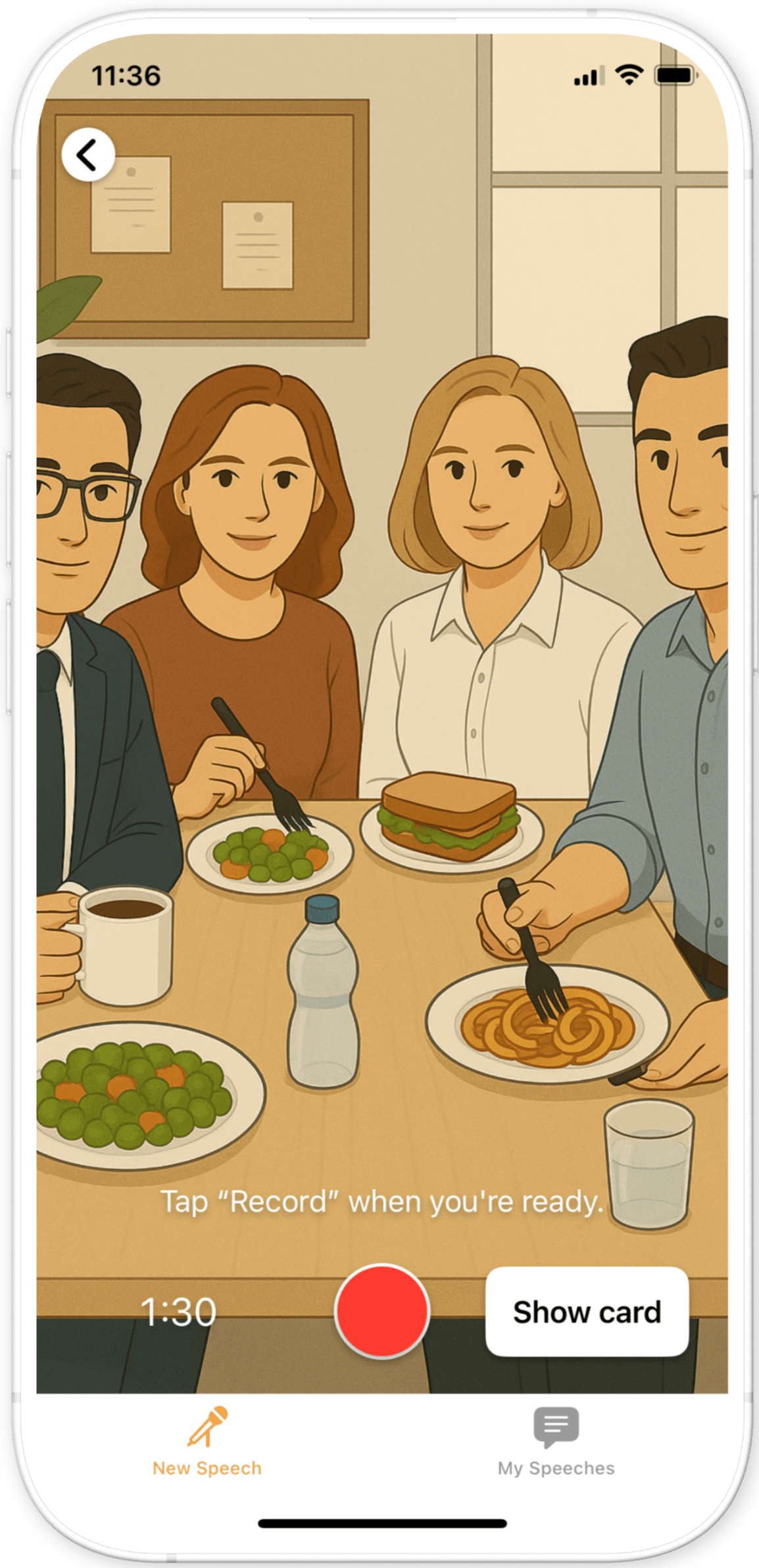
<p data-start="4100" data-end="4573">Speaking like a leader requires practice in real situations: addressing a team, pitching an idea, or motivating people after a setback. With <a href="https://apps.apple.com/us/app/public-speaking-coach-babli/id6746377369" target="_blank" rel="noopener noreferrer"><strong>Babli</strong></a>, you can rehearse scenarios such as giving a speech as a team leader, presenting a vision for a project, or asking for resources in a workplace setting. Babli gives you feedback not only on your content but also on your delivery, including pace, clarity, and filler words. With repetition, these skills become second nature.</p>
<figure ><figure class="post__image post__image--left"><img loading="lazy"  src="https://publicspeakingcoach.app/blog/media/posts/13/team_lunch.png" alt="Screenshot from the Babli app showing a team lunch scenario where the user practices giving a casual workplace speech." width="1154" height="2385" sizes="(max-width: 1920px) 100vw, 1920px" srcset="https://publicspeakingcoach.app/blog/media/posts/13/responsive/team_lunch-xs.png 640w ,https://publicspeakingcoach.app/blog/media/posts/13/responsive/team_lunch-sm.png 768w ,https://publicspeakingcoach.app/blog/media/posts/13/responsive/team_lunch-md.png 1024w ,https://publicspeakingcoach.app/blog/media/posts/13/responsive/team_lunch-lg.png 1366w ,https://publicspeakingcoach.app/blog/media/posts/13/responsive/team_lunch-xl.png 1600w ,https://publicspeakingcoach.app/blog/media/posts/13/responsive/team_lunch-2xl.png 1920w"></figure>
<figcaption >Example of a team lunch practice scenario in <a href="https://apps.apple.com/us/app/public-speaking-coach-babli/id6746377369" target="_blank" rel="noopener noreferrer">Babli</a></figcaption>
</figure>
<hr data-start="4575" data-end="4578">
<h2 data-start="4580" data-end="4597">Key Takeaway</h2>
<p data-start="4598" data-end="4806">Speaking like a leader is about habits, not personality. When you focus on clarity, pacing, storytelling, confidence, and shifting attention to your team, you start to project authority that inspires trust.</p>
<p data-start="4808" data-end="5063"><a href="https://apps.apple.com/us/app/public-speaking-coach-babli/id6746377369" target="_blank" rel="noopener noreferrer"><strong>Babli</strong></a> helps you build these habits by letting you practice leadership scenarios in a realistic environment. With detailed feedback on how you come across, you can refine both your words and delivery until you sound like the leader people want to follow.</p>
            ]]>
        </content>
    </entry>
    <entry>
        <title>3 Most Common Interview Questions and How to Answer Them</title>
        <author>
            <name>Public Speaking Coach: Babli</name>
        </author>
        <link href="https://publicspeakingcoach.app/blog/3-most-common-interview-questions-and-how-to-answer-them.html"/>
        <id>https://publicspeakingcoach.app/blog/3-most-common-interview-questions-and-how-to-answer-them.html</id>
        <media:content url="https://publicspeakingcoach.app/blog/media/posts/12/vitaly-gariev-DqejA83RZng-unsplash-min.jpg" medium="image" />

        <updated>2025-08-18T16:30:04+02:00</updated>
            <summary>
                <![CDATA[
                        <img src="https://publicspeakingcoach.app/blog/media/posts/12/vitaly-gariev-DqejA83RZng-unsplash-min.jpg" alt="Woman sitting on a couch during a job interview with a man holding a clipboard in an office setting." />
                    Job interviews can be stressful, but the truth is that most questions are not surprises. Hiring managers rely on a few predictable questions to learn about you, your self-awareness, and your fit for the role. By preparing for these questions in advance, you can walk&hellip;
                ]]>
            </summary>
        <content type="html">
            <![CDATA[
                    <p><img src="https://publicspeakingcoach.app/blog/media/posts/12/vitaly-gariev-DqejA83RZng-unsplash-min.jpg" class="type:primaryImage" alt="Woman sitting on a couch during a job interview with a man holding a clipboard in an office setting." /></p>
                <p data-start="186" data-end="514"><strong>Job interviews</strong> can be stressful, but the truth is that most questions are not surprises. Hiring managers rely on a few predictable questions to learn about you, your self-awareness, and your fit for the role. By preparing for these questions in advance, you can walk into the room with confidence and make a strong impression.</p>
<p data-start="516" data-end="644">This article breaks down the three most common interview questions and shows you how to answer them clearly and authentically.</p>
<hr data-start="646" data-end="649">
<h2 data-start="651" data-end="693">Question 1: “Tell me about yourself.”</h2>
<p data-start="694" data-end="825"><strong data-start="694" data-end="714">Why it is asked:</strong> Interviewers want to see how you present yourself and whether you can summarize your story in a focused way.</p>
<p data-start="827" data-end="847"><strong data-start="827" data-end="845">How to answer:</strong></p>
<ul data-start="848" data-end="1089">
<li data-start="848" data-end="894">
<p data-start="850" data-end="894">Keep it short, ideally 90 seconds or less.</p>
</li>
<li data-start="895" data-end="1089">
<p data-start="897" data-end="946">Structure your answer as past, present, future:</p>
<ul data-start="950" data-end="1089">
<li data-start="950" data-end="1000">
<p data-start="952" data-end="1000">Past: A quick background relevant to the role.</p>
</li>
<li data-start="1004" data-end="1040">
<p data-start="1006" data-end="1040">Present: What you are doing now.</p>
</li>
<li data-start="1044" data-end="1089">
<p data-start="1046" data-end="1089">Future: Why this opportunity excites you.</p>
</li>
</ul>
</li>
</ul>
<p data-start="1091" data-end="1367"><strong data-start="1091" data-end="1103">Example:</strong><br data-start="1103" data-end="1106">“I started my career in customer service where I learned how to solve problems under pressure. I now manage a small team and enjoy coaching others. I am excited about this role because it combines leadership with the chance to work more closely with clients.”</p>
<hr data-start="1369" data-end="1372">
<h2 data-start="1374" data-end="1423">Question 2: “What is your biggest weakness?”</h2>
<p data-start="1424" data-end="1528"><strong data-start="1424" data-end="1444">Why it is asked:</strong> Employers want to know if you are self-aware and committed to improving yourself.</p>
<p data-start="1530" data-end="1550"><strong data-start="1530" data-end="1548">How to answer:</strong></p>
<ul data-start="1551" data-end="1687">
<li data-start="1551" data-end="1597">
<p data-start="1553" data-end="1597">Avoid clichés like “I am a perfectionist.”</p>
</li>
<li data-start="1598" data-end="1640">
<p data-start="1600" data-end="1640">Pick a real but non-critical weakness.</p>
</li>
<li data-start="1641" data-end="1687">
<p data-start="1643" data-end="1687">Explain how you are working to improve it.</p>
</li>
</ul>
<p data-start="1689" data-end="1982"><strong data-start="1689" data-end="1701">Example:</strong><br data-start="1701" data-end="1704">“In the past, I found it difficult to delegate because I liked to make sure everything was done perfectly. I have been working on this by setting clearer expectations upfront and giving team members more ownership. It has helped me build trust and improve overall efficiency.”</p>
<hr data-start="1984" data-end="1987">
<h2 data-start="1989" data-end="2031">Question 3: “Why should we hire you?”</h2>
<p data-start="2032" data-end="2138"><strong data-start="2032" data-end="2052">Why it is asked:</strong> This is your opportunity to summarize your strengths and show how you fit the role.</p>
<p data-start="2140" data-end="2160"><strong data-start="2140" data-end="2158">How to answer:</strong></p>
<ul data-start="2161" data-end="2310">
<li data-start="2161" data-end="2216">
<p data-start="2163" data-end="2216">Focus on your skills, cultural fit, and motivation.</p>
</li>
<li data-start="2217" data-end="2285">
<p data-start="2219" data-end="2285">Highlight one or two strengths that directly match the position.</p>
</li>
<li data-start="2286" data-end="2310">
<p data-start="2288" data-end="2310">End with enthusiasm.</p>
</li>
</ul>
<p data-start="2312" data-end="2561"><strong data-start="2312" data-end="2324">Example:</strong><br data-start="2324" data-end="2327">“With my background in project management and my record of delivering on tight deadlines, I can help keep your upcoming initiatives on track. I also admire your company’s focus on innovation, which makes me motivated to contribute.”</p>
<hr data-start="2563" data-end="2566">
<h2 data-start="2568" data-end="2606">Practice These Scenarios in Babli</h2>
<p data-start="2607" data-end="2829">Knowing how to answer interview questions is only half the battle. Success depends on delivery as much as content. Your confidence, pacing, tone, and ability to avoid filler words all shape how your answers are received.</p>
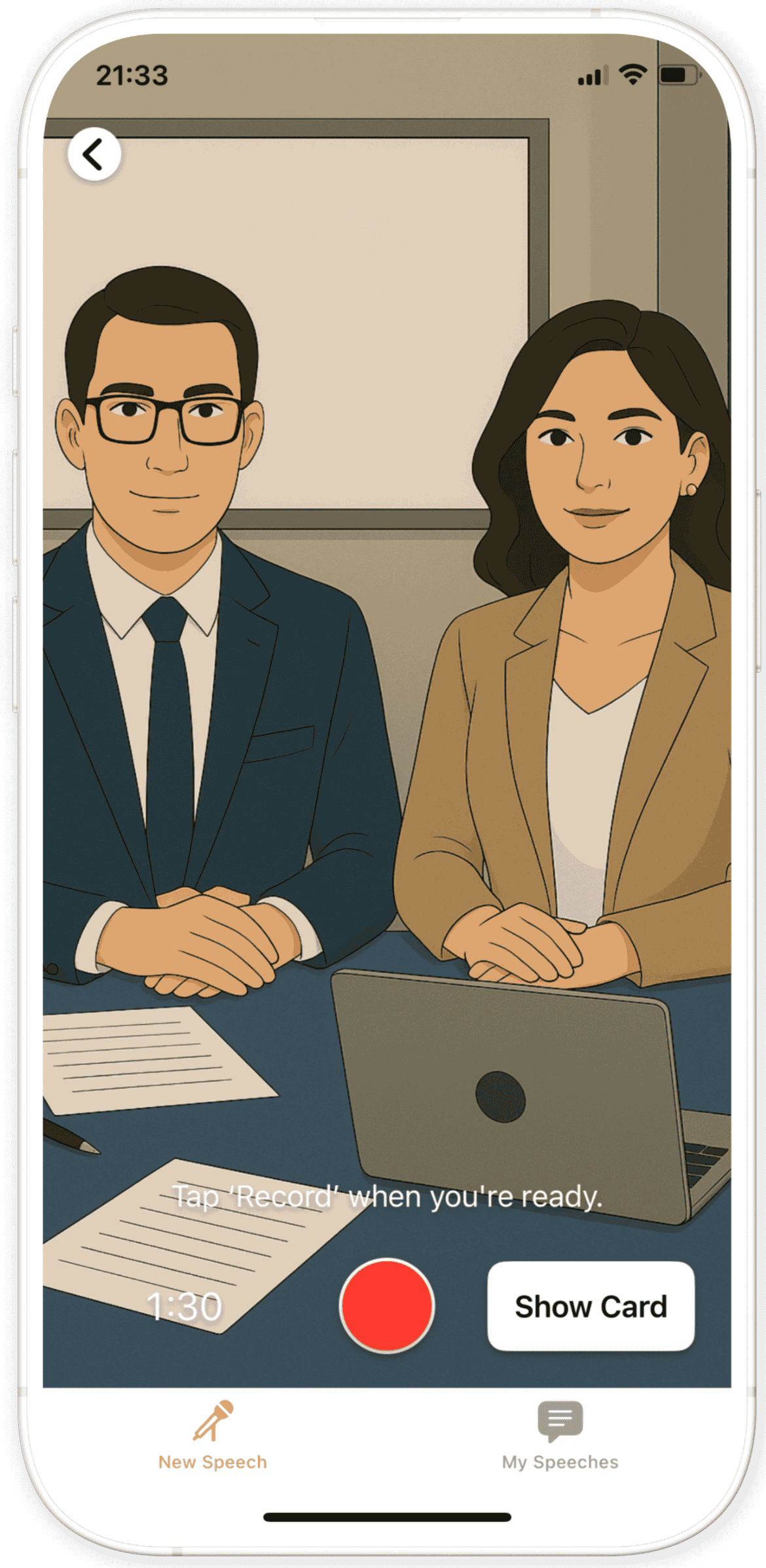
<p data-start="2831" data-end="3403">With <a href="https://apps.apple.com/us/app/public-speaking-coach-babli/id6746377369" target="_blank" rel="noopener noreferrer"><strong>Babli</strong></a>, you can practice realistic interview scenarios that include these common questions and many more. You can also rehearse workplace situations such as asking for a raise in salary, presenting to your team, or giving a speech as a leader. Babli gives you feedback not only on the quality of your answers, but also on your delivery. You will know how clear you sounded, how well you managed your pace, and whether you relied on filler words. That way, you go into the real interview with the confidence that you have practiced both what to say and how to say it.</p>
<figure ><figure class="post__image post__image--left"><img loading="lazy"  src="https://publicspeakingcoach.app/blog/media/posts/12/interview.png" alt="Screenshot from Babli app showing a job interview practice scenario." width="1170" height="2395" sizes="(max-width: 1920px) 100vw, 1920px" srcset="https://publicspeakingcoach.app/blog/media/posts/12/responsive/interview-xs.png 640w ,https://publicspeakingcoach.app/blog/media/posts/12/responsive/interview-sm.png 768w ,https://publicspeakingcoach.app/blog/media/posts/12/responsive/interview-md.png 1024w ,https://publicspeakingcoach.app/blog/media/posts/12/responsive/interview-lg.png 1366w ,https://publicspeakingcoach.app/blog/media/posts/12/responsive/interview-xl.png 1600w ,https://publicspeakingcoach.app/blog/media/posts/12/responsive/interview-2xl.png 1920w"></figure>
<figcaption >Example of a job interview practice scenario in <a href="https://apps.apple.com/us/app/public-speaking-coach-babli/id6746377369" target="_blank" rel="noopener noreferrer">Babli</a></figcaption>
</figure>
<hr data-start="3405" data-end="3408">
<h2 data-start="3410" data-end="3427">Key Takeaway</h2>
<p data-start="3428" data-end="3789">Interviews do not have to feel like guesswork. By preparing for the most common questions, structuring your answers effectively, and practicing your delivery, you can stand out from other candidates. With <a href="https://apps.apple.com/us/app/public-speaking-coach-babli/id6746377369" target="_blank" rel="noopener noreferrer"><strong>Babli</strong></a>, you can simulate these situations as often as you like, receive detailed feedback, and train yourself to perform at your best when it matters most.</p>
            ]]>
        </content>
    </entry>
    <entry>
        <title>5 Steps to Overcome Public Speaking Anxiety and Speak with Confidence</title>
        <author>
            <name>Public Speaking Coach: Babli</name>
        </author>
        <link href="https://publicspeakingcoach.app/blog/how-to-overcome-public-speaking-anxiety-proven-techniques-to-calm-your-nerves.html"/>
        <id>https://publicspeakingcoach.app/blog/how-to-overcome-public-speaking-anxiety-proven-techniques-to-calm-your-nerves.html</id>
        <media:content url="https://publicspeakingcoach.app/blog/media/posts/11/siora-photography-hgFY1mZY-Y0-unsplash-min.jpg" medium="image" />

        <updated>2025-08-17T15:21:05+02:00</updated>
            <summary>
                <![CDATA[
                        <img src="https://publicspeakingcoach.app/blog/media/posts/11/siora-photography-hgFY1mZY-Y0-unsplash-min.jpg" alt="Woman standing against a brick wall with an open book covering her face." />
                    Public speaking anxiety is one of the most common fears people face. The difference between anxious speakers and confident ones is not the absence of nerves but the ability to manage them. Confidence comes from training your body and mind to respond differently when you&hellip;
                ]]>
            </summary>
        <content type="html">
            <![CDATA[
                    <p><img src="https://publicspeakingcoach.app/blog/media/posts/11/siora-photography-hgFY1mZY-Y0-unsplash-min.jpg" class="type:primaryImage" alt="Woman standing against a brick wall with an open book covering her face." /></p>
                <p data-start="275" data-end="577"><strong>Public speaking anxiety</strong> is one of the most common fears people face. The difference between anxious speakers and confident ones is not the absence of nerves but the ability to manage them. Confidence comes from training your body and mind to respond differently when you step in front of an audience.</p>
<p data-start="579" data-end="772">This guide breaks down five proven steps you can follow. Each step combines psychology, practical exercises, and exposure so that you can reduce anxiety and deliver your message with clarity.</p>
<hr data-start="774" data-end="777">
<h2 data-start="779" data-end="811">Step 1: Reframe Preparation</h2>
<p data-start="812" data-end="1016">Many people prepare in ways that make anxiety worse. Memorizing word-for-word scripts sets you up to panic if you forget a single line. Good preparation is not about perfection. It is about familiarity.</p>
<ul data-start="1018" data-end="1219">
<li data-start="1018" data-end="1062">
<p data-start="1020" data-end="1062">Break your speech into three key points.</p>
</li>
<li data-start="1063" data-end="1128">
<p data-start="1065" data-end="1128">Use keywords or bullet points as anchors, not full sentences.</p>
</li>
<li data-start="1129" data-end="1219">
<p data-start="1131" data-end="1219">Polish only your opening and closing lines so you always know how to start and finish.</p>
</li>
</ul>
<p data-start="1221" data-end="1307">If you want to sharpen your ending, see <em data-start="1261" data-end="1304"><a href="https://publicspeakingcoach.app/blog/how-to-end-a-speech-so-people-remember-it.html" target="_blank" rel="noopener noreferrer">How to End a Speech So People Remember It</a></em>.</p>
<hr data-start="1309" data-end="1312">
<h2 data-start="1314" data-end="1359">Step 2: Use Exposure, Not Just Rehearsal</h2>
<p data-start="1360" data-end="1597">Reading your speech silently or running through it once or twice at home does little to reduce anxiety. What works is <strong data-start="1478" data-end="1490">exposure</strong>. The more often you place yourself in the speaking situation, the more your body learns that it is safe.</p>
<p data-start="1599" data-end="1777">Psychologists use exposure therapy to treat phobias, and it works for public speaking too. Each time you face the stress of being watched, the fight-or-flight response weakens.</p>
<p data-start="1779" data-end="1805">Here is how to apply it:</p>
<ol data-start="1807" data-end="2272">
<li data-start="1807" data-end="2000">
<p data-start="1810" data-end="2000"><strong data-start="1810" data-end="1828">At-home drills</strong>: Start with the exercises in <em data-start="1858" data-end="1929"><a href="https://publicspeakingcoach.app/blog/how-to-practice-public-speaking-at-home-5-simple-exercises-that-work.html" target="_blank" rel="noopener noreferrer">How to Practice Public Speaking at Home: 5 Simple Exercises That Work</a></em>.</p>
</li>
<li data-start="2001" data-end="2120">
<p data-start="2004" data-end="2120"><strong data-start="2004" data-end="2024">Raise the stakes</strong>: Add one or two people as your audience. Notice your nerves spike, then fade as you continue.</p>
</li>
<li data-start="2121" data-end="2272">
<p data-start="2124" data-end="2272"><strong data-start="2124" data-end="2151">Simulate the real thing</strong>: The hardest part to recreate is the feeling of eyes on you. That pressure is what makes real speaking feel different.</p>
</li>
</ol>
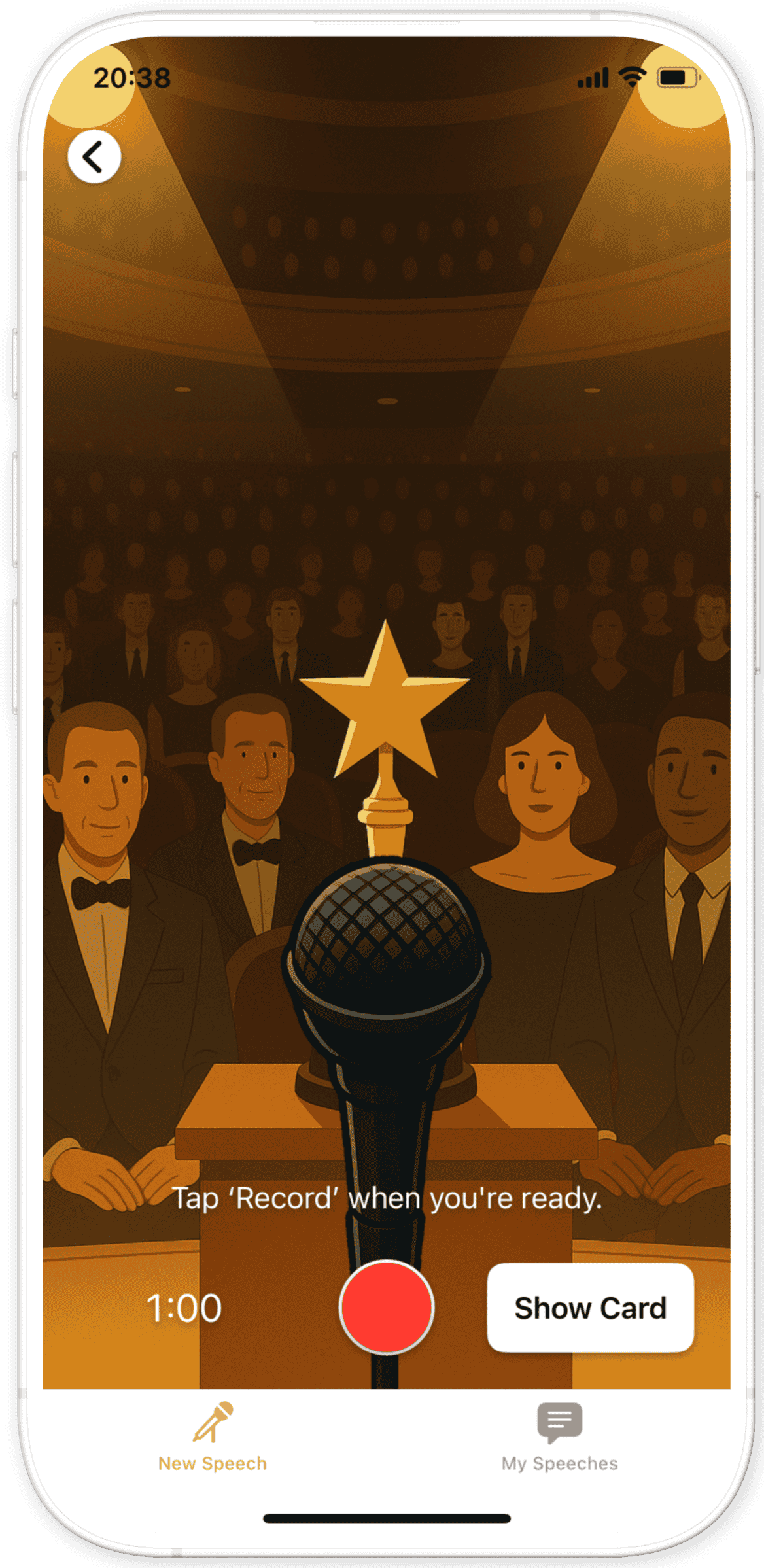
<p data-start="2274" data-end="2584"><a href="https://apps.apple.com/us/app/public-speaking-coach-babli/id6746377369" target="_blank" rel="noopener noreferrer"><strong>Babli</strong></a> was designed for this. It creates lifelike practice environments where you face a virtual audience, experience silences between your sentences, and receive feedback. By training in these conditions, your nervous system adapts so that when you face a real audience, the stress response is already lower.</p>
<figure ><figure class="post__image post__image--left"><img loading="lazy"  src="https://publicspeakingcoach.app/blog/media/posts/11/best-award.png" alt="Screenshot from the Babli app showing a virtual audience watching a speaker on stage during an award acceptance scenario." width="1168" height="2397" sizes="(max-width: 1920px) 100vw, 1920px" srcset="https://publicspeakingcoach.app/blog/media/posts/11/responsive/best-award-xs.png 640w ,https://publicspeakingcoach.app/blog/media/posts/11/responsive/best-award-sm.png 768w ,https://publicspeakingcoach.app/blog/media/posts/11/responsive/best-award-md.png 1024w ,https://publicspeakingcoach.app/blog/media/posts/11/responsive/best-award-lg.png 1366w ,https://publicspeakingcoach.app/blog/media/posts/11/responsive/best-award-xl.png 1600w ,https://publicspeakingcoach.app/blog/media/posts/11/responsive/best-award-2xl.png 1920w"></figure>
<figcaption >Example of an award acceptance speech scenario from <a href="https://apps.apple.com/us/app/public-speaking-coach-babli/id6746377369" target="_blank" rel="noopener noreferrer">Babli</a>.</figcaption>
</figure>
<hr data-start="2586" data-end="2589">
<h2 data-start="2591" data-end="2625">Step 3: Train Your Physiology</h2>
<p data-start="2626" data-end="2763">Even with preparation and exposure, nerves can still show up. The key is learning how to calm your body quickly so you stay in control.</p>
<ul data-start="2765" data-end="3085">
<li data-start="2765" data-end="2867">
<p data-start="2767" data-end="2867"><strong data-start="2767" data-end="2784">Box breathing</strong>: Inhale for 4 seconds, hold for 4, exhale for 4, hold for 4. Repeat three times.</p>
</li>
<li data-start="2868" data-end="2974">
<p data-start="2870" data-end="2974"><strong data-start="2870" data-end="2896">Progressive relaxation</strong>: Tense and release your shoulders, fists, or jaw to release hidden tension.</p>
</li>
<li data-start="2975" data-end="3085">
<p data-start="2977" data-end="3085"><strong data-start="2977" data-end="2990">Grounding</strong>: Focus on contact points such as feet on the floor or hands on a lectern to anchor yourself.</p>
</li>
</ul>
<p data-start="3087" data-end="3174">These techniques signal safety to your brain and slow down the release of adrenaline.</p>
<hr data-start="3176" data-end="3179">
<h2 data-start="3181" data-end="3218">Step 4: Own the First 60 Seconds</h2>
<p data-start="3219" data-end="3371">The opening of a speech feels hardest because adrenaline peaks just before you begin. Once you are into your talk, your body usually starts to settle.</p>
<p data-start="3373" data-end="3400">To make the start easier:</p>
<ul data-start="3401" data-end="3616">
<li data-start="3401" data-end="3471">
<p data-start="3403" data-end="3471">Memorize your first two sentences so you begin without hesitation.</p>
</li>
<li data-start="3472" data-end="3524">
<p data-start="3474" data-end="3524">Make eye contact with one or two friendly faces.</p>
</li>
<li data-start="3525" data-end="3616">
<p data-start="3527" data-end="3616">Pause before speaking. A short silence creates authority and helps you ground yourself.</p>
</li>
</ul>
<p data-start="3618" data-end="3696">If you control the opening minute, momentum will carry you through the rest.</p>
<hr data-start="3698" data-end="3701">
<h2 data-start="3703" data-end="3742">Step 5: Shift From Self to Service</h2>
<p data-start="3743" data-end="3913">Anxiety grows when your thoughts are inward: <em data-start="3788" data-end="3833">How do I sound? What if I forget something?</em> Confidence grows when your focus shifts outward: <em data-start="3883" data-end="3911">What do they need to hear?</em></p>
<ul data-start="3915" data-end="4093">
<li data-start="3915" data-end="3980">
<p data-start="3917" data-end="3980">Think of your talk as a message that will help your audience.</p>
</li>
<li data-start="3981" data-end="4031">
<p data-start="3983" data-end="4031">Replace self-judgment with audience awareness.</p>
</li>
<li data-start="4032" data-end="4093">
<p data-start="4034" data-end="4093">Treat your delivery as a conversation, not a performance.</p>
</li>
</ul>
<p data-start="4095" data-end="4165">This mindset shift reduces self-consciousness and builds connection.</p>
<hr data-start="4167" data-end="4170">
<h2 data-start="4172" data-end="4189">Key Takeaway</h2>
<p data-start="4190" data-end="4430">Public speaking anxiety is natural, but it does not have to control you. By reframing preparation, using exposure, calming your body, mastering the first 60 seconds, and focusing on your audience, you can retrain your system to stay calm.</p>
<p data-start="4432" data-end="4730"><a href="https://apps.apple.com/us/app/public-speaking-coach-babli/id6746377369" target="_blank" rel="noopener noreferrer"><strong>Babli</strong></a> makes this process faster. Instead of waiting for rare speaking opportunities, you can simulate them as often as you like. By practicing in lifelike environments, your body learns to handle the pressure of being watched. Over time, the stress response fades, and confidence takes its place.</p>
<p data-start="4732" data-end="4914">Nerves may never disappear entirely, but with the right kind of practice, they become manageable. Eventually, they become the energy that powers a strong and memorable performance.</p>
            ]]>
        </content>
    </entry>
    <entry>
        <title>How to Practice Public Speaking at Home: 5 Simple Exercises That Work</title>
        <author>
            <name>Public Speaking Coach: Babli</name>
        </author>
        <link href="https://publicspeakingcoach.app/blog/how-to-practice-public-speaking-at-home-5-simple-exercises-that-work.html"/>
        <id>https://publicspeakingcoach.app/blog/how-to-practice-public-speaking-at-home-5-simple-exercises-that-work.html</id>
        <media:content url="https://publicspeakingcoach.app/blog/media/posts/10/marlon-lara-m31VZ94asBQ-unsplash-min.jpg" medium="image" />

        <updated>2025-08-17T11:37:04+02:00</updated>
            <summary>
                <![CDATA[
                        <img src="https://publicspeakingcoach.app/blog/media/posts/10/marlon-lara-m31VZ94asBQ-unsplash-min.jpg" alt="Person practicing a speech in front of a mirror at home, using gestures and facial expressions for rehearsal." />
                    Public speaking is one of those skills that almost everyone wants to improve, but few people get the chance to practice regularly. You might have a big presentation coming up, a wedding toast to deliver, or just a desire to feel more confident when speaking&hellip;
                ]]>
            </summary>
        <content type="html">
            <![CDATA[
                    <p><img src="https://publicspeakingcoach.app/blog/media/posts/10/marlon-lara-m31VZ94asBQ-unsplash-min.jpg" class="type:primaryImage" alt="Person practicing a speech in front of a mirror at home, using gestures and facial expressions for rehearsal." /></p>
                <p data-start="286" data-end="695"><strong>Public speaking</strong> is one of those skills that almost everyone wants to improve, but few people get the chance to practice regularly. You might have a big presentation coming up, a wedding toast to deliver, or just a desire to feel more confident when speaking in front of others. The problem is that real opportunities to practice are rare, and waiting until the big moment often leads to nerves and mistakes.</p>
<p data-start="697" data-end="1010">The good news is that you can train effectively without an audience. With the right strategies, your home can become the perfect practice space where you sharpen your voice, body language, and confidence. Here are five simple and effective exercises you can use at home to build stronger public speaking skills.</p>
<hr data-start="1012" data-end="1015">
<h3 data-start="1017" data-end="1051">Why Practicing at Home Works</h3>
<p data-start="1053" data-end="1225">Practicing at home takes the pressure off. You can rehearse freely, experiment with different styles, and repeat sections as often as you like. Over time, this helps you:</p>
<ul data-start="1227" data-end="1506">
<li data-start="1227" data-end="1272">
<p data-start="1229" data-end="1272">Grow more comfortable with your material.</p>
</li>
<li data-start="1273" data-end="1329">
<p data-start="1275" data-end="1329">Spot habits like mumbling, filler words, or rushing.</p>
</li>
<li data-start="1330" data-end="1370">
<p data-start="1332" data-end="1370">Build confidence through repetition.</p>
</li>
<li data-start="1371" data-end="1436">
<p data-start="1373" data-end="1436">Develop flexibility by trying different tones and approaches.</p>
</li>
<li data-start="1437" data-end="1506">
<p data-start="1439" data-end="1506">Prepare for real situations instead of waiting until they arrive.</p>
</li>
</ul>
<hr data-start="1508" data-end="1511">
<h3 data-start="1513" data-end="1537">5 Simple Exercises</h3>
<h4 data-start="1539" data-end="1568">1. Read Out Loud Daily</h4>
<p data-start="1569" data-end="1865">Choose a book, article, or even your own notes and read them out loud. Focus on clarity, pacing, and energy. Take a paragraph and read it in different styles such as calm, enthusiastic, and persuasive. This strengthens vocal control and helps you adapt your delivery depending on your audience.</p>
<h4 data-start="1867" data-end="1906">2. Practice in Front of a Mirror</h4>
<p data-start="1907" data-end="2308">Stand tall, keep your shoulders relaxed, and look directly at your reflection as if it were your audience. Maintain steady eye contact, use natural hand movements, and monitor your posture. Practice telling a short story, such as how you met a friend or a challenge you overcame, and pay attention to how your expressions support your words. This builds awareness of both body language and presence.</p>
<h4 data-start="2310" data-end="2335">3. Record Yourself</h4>
<p data-start="2336" data-end="2717">Pick a short topic, like summarizing a news article or sharing your opinion on a recent trend, and record a two- to three-minute speech. Listen back for places where your tone drops, where you lose clarity, or where your sentences drag on. Then repeat the exercise while adjusting those points. Over time, this becomes one of the fastest ways to notice progress in your speaking.</p>
<h4 data-start="2719" data-end="2763">4. Simulate Real Scenarios with Babli</h4>
<p data-start="2764" data-end="2957">The most effective practice happens when you prepare for situations you might actually face. <strong data-start="2857" data-end="2866"><a href="https://apps.apple.com/us/app/public-speaking-coach-babli/id6746377369" target="_blank" rel="noopener noreferrer">Babli</a></strong> makes this possible by letting you rehearse across a wide range of scenarios, including:</p>
<ul data-start="2959" data-end="3279">
<li data-start="2959" data-end="3015">
<p data-start="2961" data-end="3015"><strong data-start="2961" data-end="2971">Events</strong> such as weddings, graduations, or toasts.</p>
</li>
<li data-start="3016" data-end="3103">
<p data-start="3018" data-end="3103"><strong data-start="3018" data-end="3046">Interviews and Workplace</strong> including meetings, presentations, and job interviews.</p>
</li>
<li data-start="3104" data-end="3163">
<p data-start="3106" data-end="3163"><strong data-start="3106" data-end="3121">Discussions</strong> such as debates or group conversations.</p>
</li>
<li data-start="3164" data-end="3214">
<p data-start="3166" data-end="3214"><strong data-start="3166" data-end="3175">Media</strong> like podcasts and press conferences.</p>
</li>
<li data-start="3215" data-end="3279">
<p data-start="3217" data-end="3279"><strong data-start="3217" data-end="3224">Fun</strong> lighthearted situations that keep practice engaging.</p>
</li>
</ul>
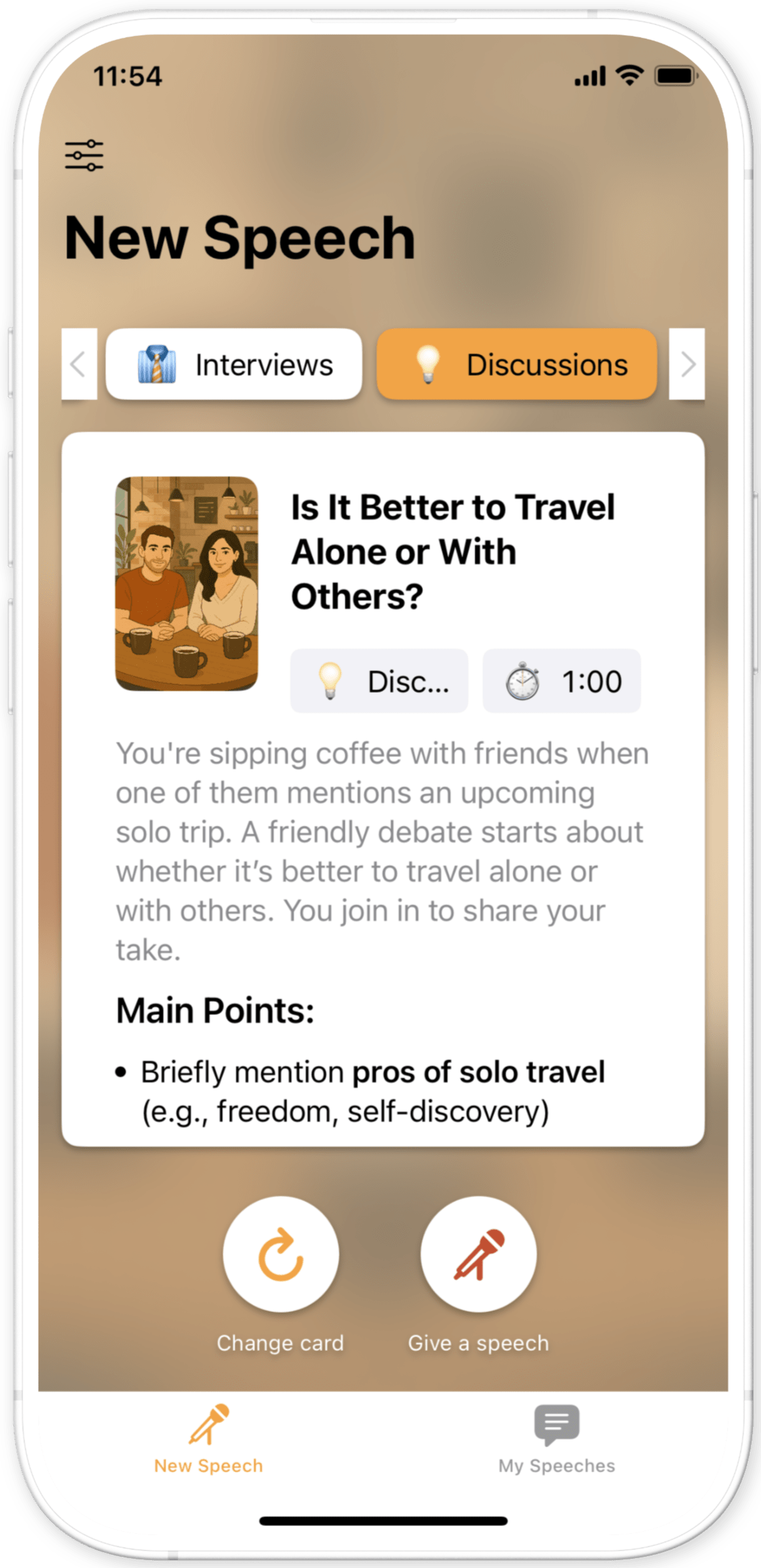
<p data-start="3281" data-end="3738">Each scenario comes with a short description of the setting and key points you might want to cover. You can improvise around these prompts to keep your delivery natural while still having a clear direction. After recording your speech, <a href="https://apps.apple.com/us/app/public-speaking-coach-babli/id6746377369" target="_blank" rel="noopener noreferrer"><strong>Babli</strong></a> provides personalized feedback along with scores, so you can see exactly where you are improving. This sense of progress makes practice motivating and keeps you working toward more confident and polished speaking.</p>
<figure ><figure class="post__image post__image--left"><img loading="lazy"  src="https://publicspeakingcoach.app/blog/media/posts/10/selecting_speech.png" alt="Screenshot of Babli app showing a selected speech scenario with a description and key points for practice." width="1160" height="2390" sizes="(max-width: 1920px) 100vw, 1920px" srcset="https://publicspeakingcoach.app/blog/media/posts/10/responsive/selecting_speech-xs.png 640w ,https://publicspeakingcoach.app/blog/media/posts/10/responsive/selecting_speech-sm.png 768w ,https://publicspeakingcoach.app/blog/media/posts/10/responsive/selecting_speech-md.png 1024w ,https://publicspeakingcoach.app/blog/media/posts/10/responsive/selecting_speech-lg.png 1366w ,https://publicspeakingcoach.app/blog/media/posts/10/responsive/selecting_speech-xl.png 1600w ,https://publicspeakingcoach.app/blog/media/posts/10/responsive/selecting_speech-2xl.png 1920w"></figure>
<figcaption >
<p data-start="224" data-end="287">Example of a speech scenario in <a href="https://apps.apple.com/us/app/public-speaking-coach-babli/id6746377369" target="_blank" rel="noopener noreferrer">Babli</a></p>
</figcaption>
</figure>
<h4 data-start="3740" data-end="3777">5. Practice Impromptu Speaking</h4>
<p data-start="3778" data-end="4210">Not every speaking opportunity gives you time to prepare. To build this skill, pick a random object around the house or open a news site and choose a headline. Speak about it for one minute without stopping. Focus on keeping a simple structure with a beginning, middle, and end while maintaining steady confidence. This exercise trains quick thinking and adaptability, two qualities that carry over to any real speaking situation.</p>
<hr data-start="4212" data-end="4215">
<h3 data-start="4217" data-end="4235">Key Takeaway</h3>
<p data-start="4237" data-end="4693">You do not always need a live audience to improve your public speaking skills. By creating your own practice space at home, you can strengthen delivery, build confidence, and prepare for important moments before they arrive. Reading out loud, practicing in front of a mirror, recording yourself, simulating real scenarios with <strong><a href="https://apps.apple.com/us/app/public-speaking-coach-babli/id6746377369" target="_blank" rel="noopener noreferrer">Babli</a></strong>, and training with impromptu speaking will give you steady progress toward clear, memorable, and confident communication.</p>
            ]]>
        </content>
    </entry>
    <entry>
        <title>How to Practice Your Wedding Speech: Tips for Every Role</title>
        <author>
            <name>Public Speaking Coach: Babli</name>
        </author>
        <link href="https://publicspeakingcoach.app/blog/how-to-practice-your-wedding-speech-tips-for-every-role.html"/>
        <id>https://publicspeakingcoach.app/blog/how-to-practice-your-wedding-speech-tips-for-every-role.html</id>
        <media:content url="https://publicspeakingcoach.app/blog/media/posts/9/sebastian-romero-aVpE5dVepy8-unsplash-min.jpg" medium="image" />

        <updated>2025-08-15T15:14:21+02:00</updated>
            <summary>
                <![CDATA[
                        <img src="https://publicspeakingcoach.app/blog/media/posts/9/sebastian-romero-aVpE5dVepy8-unsplash-min.jpg" alt="Close-up of a man in a beige suit holding a microphone and wedding rings during an outdoor ceremony." />
                    A wedding speech is a rare opportunity to share personal stories, express heartfelt gratitude, and celebrate one of the most meaningful days in someone’s life. Whether you are the bride, groom, best man, maid of honor, or a parent, your words will become part of&hellip;
                ]]>
            </summary>
        <content type="html">
            <![CDATA[
                    <p><img src="https://publicspeakingcoach.app/blog/media/posts/9/sebastian-romero-aVpE5dVepy8-unsplash-min.jpg" class="type:primaryImage" alt="Close-up of a man in a beige suit holding a microphone and wedding rings during an outdoor ceremony." /></p>
                <p data-start="200" data-end="504"><strong>A wedding speech</strong> is a rare opportunity to share personal stories, express heartfelt gratitude, and celebrate one of the most meaningful days in someone’s life. Whether you are the bride, groom, best man, maid of honor, or a parent, your words will become part of the memories people carry from the day.</p>
<p data-start="506" data-end="737">A great wedding speech is not about being perfect. It is about being prepared, intentional, and sincere. By shaping your content thoughtfully and practicing it ahead of time, you can ensure your message lands exactly as you hope.</p>
<hr data-start="739" data-end="742">
<h3 data-start="744" data-end="783">Why Wedding Speech Practice Matters</h3>
<p data-start="785" data-end="909">At a wedding, you are speaking to people you care about in a setting filled with emotion. The right preparation helps you:</p>
<ul data-start="911" data-end="1166">
<li data-start="911" data-end="982">
<p data-start="913" data-end="982">Choose stories that truly connect with the couple and the audience.</p>
</li>
<li data-start="983" data-end="1047">
<p data-start="985" data-end="1047">Keep your speech focused and free from unnecessary tangents.</p>
</li>
<li data-start="1048" data-end="1108">
<p data-start="1050" data-end="1108">Build momentum so your ending feels strong and complete.</p>
</li>
<li data-start="1109" data-end="1166">
<p data-start="1111" data-end="1166">Strike the right balance between humor and sentiment.</p>
</li>
</ul>
<hr data-start="1168" data-end="1171">
<h3 data-start="1173" data-end="1210">Practicing from Every Perspective</h3>
<p data-start="1212" data-end="1394">The role you play in the wedding will naturally shape your message. Thinking about your role early makes it easier to choose stories, set the right tone, and avoid awkward moments.</p>
<ul data-start="1396" data-end="2539">
<li data-start="1396" data-end="1695">
<p data-start="1398" data-end="1695"><strong data-start="1398" data-end="1416">Bride or Groom</strong> – Share your journey as a couple, acknowledge the people who have supported you, and speak directly to your partner. Keep your words heartfelt, but avoid retelling your entire relationship history. A short, meaningful moment often has more impact than a long list of memories.</p>
</li>
<li data-start="1697" data-end="1966">
<p data-start="1699" data-end="1966"><strong data-start="1699" data-end="1711">Best Man</strong> – Mix humor with warmth. A funny anecdote can help break the ice, but balance it with genuine praise for the couple. Avoid anything too embarrassing or difficult to explain to the entire audience. End on a sincere note to show respect for the occasion.</p>
</li>
<li data-start="1968" data-end="2244">
<p data-start="1970" data-end="2244"><strong data-start="1970" data-end="1987">Maid of Honor</strong> – Focus on the friendship you share and the qualities you admire most. Weave in a short story that shows these traits in action. Keep your tone heartfelt but uplifting, so your words feel like a celebration of both people, not just the one you know best.</p>
</li>
<li data-start="2246" data-end="2539">
<p data-start="2248" data-end="2539"><strong data-start="2248" data-end="2280">Parent of the Bride or Groom</strong> – Offer a perspective that only you can give. This could be a story from childhood, a piece of wisdom, or a reflection on seeing your child grow into adulthood. Keep it warm and encouraging, and speak to the couple as they begin their new chapter together.</p>
</li>
</ul>
<hr data-start="2541" data-end="2544">
<h3 data-start="2546" data-end="2576">How to Refine Your Content</h3>
<p data-start="2578" data-end="2670">Once you have written your draft, the real work begins. Read it out loud and ask yourself:</p>
<ul data-start="2672" data-end="2829">
<li data-start="2672" data-end="2720">
<p data-start="2674" data-end="2720">Does the opening grab attention immediately?</p>
</li>
<li data-start="2721" data-end="2768">
<p data-start="2723" data-end="2768">Are the stories concise and easy to follow?</p>
</li>
<li data-start="2769" data-end="2829">
<p data-start="2771" data-end="2829">Does the speech naturally build toward a strong closing?</p>
</li>
</ul>
<p data-start="2831" data-end="3125">This is where <strong data-start="2845" data-end="2854"><a href="https://apps.apple.com/us/app/public-speaking-coach-babli/id6746377369" target="_blank" rel="noopener noreferrer">Babli</a></strong> can help. You can rehearse your wedding speech from any role perspective and receive feedback that covers everything from structure and clarity to delivery and language. This allows you to fine-tune your message so it feels polished and impactful when it matters most.</p>
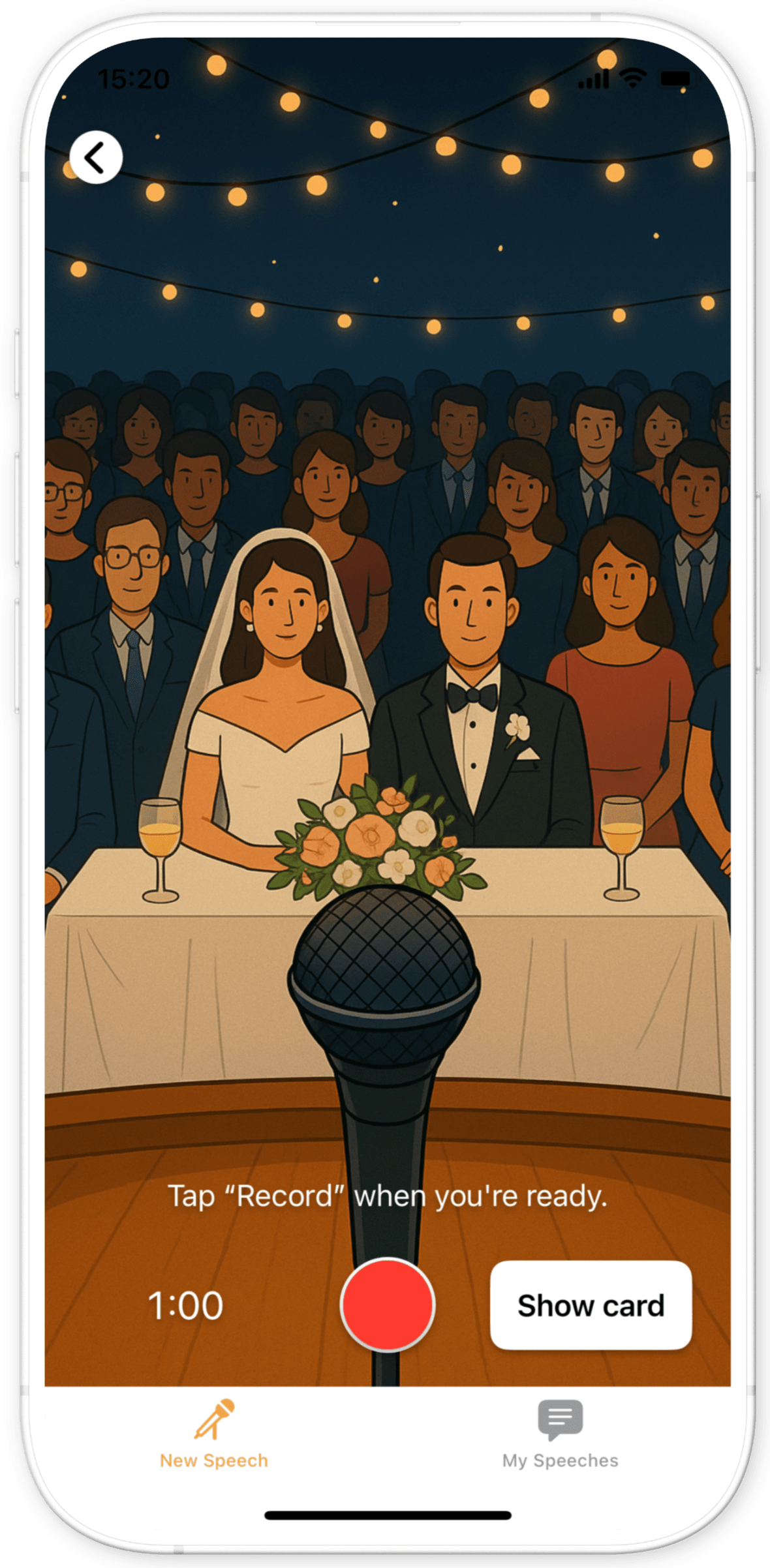
<figure ><figure class="post__image post__image--left"><img loading="lazy"  src="https://publicspeakingcoach.app/blog/media/posts/9/wedding_speech.png" alt="Screenshot of Babli app showing a wedding speech scenario ready to be delivered." width="1180" height="2404" sizes="(max-width: 1920px) 100vw, 1920px" srcset="https://publicspeakingcoach.app/blog/media/posts/9/responsive/wedding_speech-xs.png 640w ,https://publicspeakingcoach.app/blog/media/posts/9/responsive/wedding_speech-sm.png 768w ,https://publicspeakingcoach.app/blog/media/posts/9/responsive/wedding_speech-md.png 1024w ,https://publicspeakingcoach.app/blog/media/posts/9/responsive/wedding_speech-lg.png 1366w ,https://publicspeakingcoach.app/blog/media/posts/9/responsive/wedding_speech-xl.png 1600w ,https://publicspeakingcoach.app/blog/media/posts/9/responsive/wedding_speech-2xl.png 1920w"></figure>
<figcaption >Example of a wedding speech scenario from <a href="https://apps.apple.com/us/app/public-speaking-coach-babli/id6746377369" target="_blank" rel="noopener noreferrer">Babli</a></figcaption>
</figure>
<hr data-start="3127" data-end="3130">
<h3 data-start="3132" data-end="3170">What Not to Do in a Wedding Speech</h3>
<p data-start="3172" data-end="3404">While a wedding speech is your chance to be creative and personal, there are a few pitfalls that can make it awkward or uncomfortable for the audience. Avoiding these will help keep your speech warm, respectful, and well-received.</p>
<ul data-start="3406" data-end="3863">
<li data-start="3406" data-end="3488">
<p data-start="3408" data-end="3488"><strong data-start="3408" data-end="3439">Do not embarrass the couple</strong> with overly personal or inappropriate stories.</p>
</li>
<li data-start="3489" data-end="3555">
<p data-start="3491" data-end="3555"><strong data-start="3491" data-end="3513">Avoid inside jokes</strong> that only a few guests will understand.</p>
</li>
<li data-start="3556" data-end="3629">
<p data-start="3558" data-end="3629"><strong data-start="3558" data-end="3591">Do not make it about yourself</strong>; the focus should be on the couple.</p>
</li>
<li data-start="3630" data-end="3715">
<p data-start="3632" data-end="3715"><strong data-start="3632" data-end="3673">Skip overly negative humor or sarcasm</strong>, even if you think it will get a laugh.</p>
</li>
<li data-start="3716" data-end="3810">
<p data-start="3718" data-end="3810"><strong data-start="3718" data-end="3760">Avoid reading directly from your phone</strong> without eye contact, which can feel impersonal.</p>
</li>
<li data-start="3811" data-end="3863">
<p data-start="3813" data-end="3863"><strong data-start="3813" data-end="3830">Do not ramble</strong>; keep it concise and engaging.</p>
</li>
</ul>
<p data-start="3865" data-end="3986">By steering clear of these common mistakes, you create a space where your words can shine and truly honor the occasion.</p>
<hr data-start="3988" data-end="3991">
<h3 data-start="3993" data-end="4009">Key Takeaway</h3>
<p data-start="4011" data-end="4410">A wedding speech is a personal tribute that can make the celebration even more memorable. By preparing well, choosing the right stories, and practicing until your words feel natural, you can speak with both confidence and authenticity. Using <a href="https://apps.apple.com/us/app/public-speaking-coach-babli/id6746377369" target="_blank" rel="noopener noreferrer"><strong>Babli</strong></a> to rehearse from any perspective and get targeted feedback ensures that when the moment comes, your speech is polished, heartfelt, and unforgettable.</p>
            ]]>
        </content>
    </entry>
    <entry>
        <title>How to End a Speech So People Remember It</title>
        <author>
            <name>Public Speaking Coach: Babli</name>
        </author>
        <link href="https://publicspeakingcoach.app/blog/how-to-end-a-speech-so-people-remember-it.html"/>
        <id>https://publicspeakingcoach.app/blog/how-to-end-a-speech-so-people-remember-it.html</id>
        <media:content url="https://publicspeakingcoach.app/blog/media/posts/8/herlambang-tinasih-gusti-ymBs1mVim8-unsplash-min.jpg" medium="image" />

        <updated>2025-08-14T15:20:26+02:00</updated>
            <summary>
                <![CDATA[
                        <img src="https://publicspeakingcoach.app/blog/media/posts/8/herlambang-tinasih-gusti-ymBs1mVim8-unsplash-min.jpg" alt="Speaker holding a microphone on stage, addressing a large audience with phone flashlights raised." />
                    A strong ending can turn a good speech into a memorable one. Your conclusion is the final impression you leave with your audience. It should be clear, impactful, and aligned with your main message. Too many speakers rush through their closing words or trail off&hellip;
                ]]>
            </summary>
        <content type="html">
            <![CDATA[
                    <p><img src="https://publicspeakingcoach.app/blog/media/posts/8/herlambang-tinasih-gusti-ymBs1mVim8-unsplash-min.jpg" class="type:primaryImage" alt="Speaker holding a microphone on stage, addressing a large audience with phone flashlights raised." /></p>
                <p data-start="193" data-end="510"><strong>A strong ending</strong> can turn a good speech into a memorable one. Your conclusion is the final impression you leave with your audience. It should be clear, impactful, and aligned with your main message. Too many speakers rush through their closing words or trail off awkwardly, missing the chance to inspire and connect.</p>
<hr data-start="512" data-end="515">
<h3 data-start="517" data-end="543">Why the Ending Matters</h3>
<p data-start="545" data-end="648">Your audience is most likely to remember two moments: the start and the end. A well-crafted conclusion:</p>
<ul data-start="650" data-end="810">
<li data-start="650" data-end="681">
<p data-start="652" data-end="681">Reinforces your key message</p>
</li>
<li data-start="682" data-end="728">
<p data-start="684" data-end="728">Leaves your audience with a clear takeaway</p>
</li>
<li data-start="729" data-end="776">
<p data-start="731" data-end="776">Creates an emotional or intellectual impact</p>
</li>
<li data-start="777" data-end="810">
<p data-start="779" data-end="810">Inspires action or reflection</p>
</li>
</ul>
<p data-start="812" data-end="884">Without a strong ending, your speech can feel unfinished or forgettable.</p>
<hr data-start="886" data-end="889">
<h3 data-start="891" data-end="928">Common Mistakes in Speech Endings</h3>
<ul data-start="930" data-end="1254">
<li data-start="930" data-end="991">
<p data-start="932" data-end="991"><strong data-start="932" data-end="951">Ending abruptly</strong> – Stopping without signaling closure.</p>
</li>
<li data-start="992" data-end="1084">
<p data-start="994" data-end="1084"><strong data-start="994" data-end="1020">Introducing new points</strong> – Confusing the audience with fresh ideas at the last second.</p>
</li>
<li data-start="1085" data-end="1156">
<p data-start="1087" data-end="1156"><strong data-start="1087" data-end="1103">Trailing off</strong> – Losing energy or confidence in your final words.</p>
</li>
<li data-start="1157" data-end="1254">
<p data-start="1159" data-end="1254"><strong data-start="1159" data-end="1179">Over-apologizing</strong> – Undercutting your message with phrases like “That’s it” or “Sorry if…”</p>
</li>
</ul>
<hr data-start="1256" data-end="1259">
<h3 data-start="1261" data-end="1296">How to End a Speech Effectively</h3>
<h3 data-start="147" data-end="182">1. Summarize Your Main Points</h3>
<p data-start="183" data-end="276">Briefly restate your core message so the audience remembers the key ideas you have covered.</p>
<p data-start="278" data-end="475"><strong data-start="278" data-end="290">Example:</strong> <em data-start="291" data-end="473">“Today we explored three ways to reduce workplace stress: prioritizing tasks, setting boundaries, and taking short breaks. Together, these small changes can make a big difference.”</em></p>
<hr data-start="477" data-end="480">
<h3 data-start="482" data-end="516">2. End with a Call to Action</h3>
<p data-start="517" data-end="592">Tell your audience exactly what you want them to think, feel, or do next.</p>
<p data-start="594" data-end="753"><strong data-start="594" data-end="606">Example:</strong> <em data-start="607" data-end="751">“If each of you commits to practicing just one of these techniques this week, you will see an immediate improvement in your focus and energy.”</em></p>
<hr data-start="755" data-end="758">
<h3 data-start="760" data-end="799">3. Use a Memorable Quote or Story</h3>
<p data-start="800" data-end="880">A short, relevant story or quotation can leave a lasting emotional impression.</p>
<p data-start="882" data-end="1039"><strong data-start="882" data-end="894">Example:</strong> <em data-start="895" data-end="1037">“As Nelson Mandela once said, ‘It always seems impossible until it is done.’ Let us carry that spirit into the challenges we face together.”</em></p>
<hr data-start="1041" data-end="1044">
<h3 data-start="1046" data-end="1079">4. Tie Back to Your Opening</h3>
<p data-start="1080" data-end="1165">Referring to your introduction creates a satisfying sense of closure and structure.</p>
<p data-start="1167" data-end="1333"><strong data-start="1167" data-end="1179">Example:</strong> <em data-start="1180" data-end="1331">“I began today by asking, ‘What would it take to feel more confident at work?’ Now you know the steps to get there, and the choice is in your hands.”</em></p>
<hr data-start="1335" data-end="1338">
<h3 data-start="1340" data-end="1374">5. Practice Your Final Lines</h3>
<p data-start="1375" data-end="1471">Your last sentence should sound confident and intentional. Rehearse it until it feels natural.</p>
<p data-start="1473" data-end="1629"><strong data-start="1473" data-end="1485">Example:</strong> <em data-start="1486" data-end="1627">Instead of ending with ‘That’s it,’ try closing with: “Thank you for your time today. I look forward to seeing the progress you will make.”</em></p>
<hr data-start="2360" data-end="2363">
<h3 data-start="2365" data-end="2408">Exercises to Strengthen Your Conclusion</h3>
<ul data-start="2410" data-end="2812">
<li data-start="2410" data-end="2521">
<p data-start="2412" data-end="2521"><strong data-start="2412" data-end="2439">The Last Sentence Drill</strong> – Practice delivering just your final sentence with maximum clarity and impact.</p>
</li>
<li data-start="2522" data-end="2691">
<p data-start="2524" data-end="2691"><strong data-start="2524" data-end="2550">Closing Story Practice</strong> – Choose a short, relevant story you could use as a speech ending and rehearse telling it in a way that builds toward a strong final line.</p>
</li>
<li data-start="2692" data-end="2812">
<p data-start="2694" data-end="2812"><strong data-start="40" data-end="62">Full Speech Review</strong> – In <a href="https://apps.apple.com/us/app/public-speaking-coach-babli/id6746377369"><strong>Babli</strong></a>, choose your speech scenario, such as a formal graduation speech or a podcast conversation, and record your speech. Then review the content feedback with a focus on the closing section, identifying which parts land well and which could be refined to leave a stronger final impression.</p>
<figure ><figure class="post__image post__image--left"><img loading="lazy"  src="https://publicspeakingcoach.app/blog/media/posts/8/content_feedback-min.png" alt="Screenshot of Babli app showing speech content feedback, including strengths, improvement suggestions, and a content score." width="1174" height="2403" sizes="(max-width: 1920px) 100vw, 1920px" srcset="https://publicspeakingcoach.app/blog/media/posts/8/responsive/content_feedback-min-xs.png 640w ,https://publicspeakingcoach.app/blog/media/posts/8/responsive/content_feedback-min-sm.png 768w ,https://publicspeakingcoach.app/blog/media/posts/8/responsive/content_feedback-min-md.png 1024w ,https://publicspeakingcoach.app/blog/media/posts/8/responsive/content_feedback-min-lg.png 1366w ,https://publicspeakingcoach.app/blog/media/posts/8/responsive/content_feedback-min-xl.png 1600w ,https://publicspeakingcoach.app/blog/media/posts/8/responsive/content_feedback-min-2xl.png 1920w"></figure>
<figcaption >Example of speech content feedback from <a href="https://apps.apple.com/us/app/public-speaking-coach-babli/id6746377369" target="_blank" rel="noopener noreferrer">Babli</a></figcaption>
</figure>
</li>
</ul>
<hr data-start="2814" data-end="2817">
<h3 data-start="2819" data-end="2835">Key Takeaway</h3>
<p data-start="2837" data-end="3157">A strong ending is not just a formality. It is your last chance to connect with your audience and make your message stick. By crafting intentional final lines and using <a href="https://apps.apple.com/us/app/public-speaking-coach-babli/id6746377369"><strong>Babli</strong></a>’s speech content feedback to refine them, you can leave listeners engaged, inspired, and remembering your words long after you finish speaking.</p>
<p data-start="2837" data-end="3157">And while endings matter, openings set the stage. For practical advice on that crucial first impression, read our guide on <a href="https://publicspeakingcoach.app/blog/how-to-start-a-speech-7-powerful-openings-that-work-every-time.html" target="_blank" rel="noopener noreferrer"><em>How to Start a Speech: 7 Powerful Openings That Work Every Time</em></a>.</p>
            ]]>
        </content>
    </entry>
    <entry>
        <title>How to Stop Saying “Um,” “Like,” and “You Know”</title>
        <author>
            <name>Public Speaking Coach: Babli</name>
        </author>
        <link href="https://publicspeakingcoach.app/blog/how-to-stop-saying-um-like-and-you-know.html"/>
        <id>https://publicspeakingcoach.app/blog/how-to-stop-saying-um-like-and-you-know.html</id>
        <media:content url="https://publicspeakingcoach.app/blog/media/posts/7/mimi-thian-lp1AKIUV3yo-unsplash-min.jpg" medium="image" />

        <updated>2025-08-14T11:36:43+02:00</updated>
            <summary>
                <![CDATA[
                        <img src="https://publicspeakingcoach.app/blog/media/posts/7/mimi-thian-lp1AKIUV3yo-unsplash-min.jpg" alt="Two women engaged in a focused conversation at a desk with a laptop, in a modern office setting." />
                    Filler words like “um,” “like,” and “you know” are common in everyday conversation, but in public speaking, they can weaken your message. They often slip in without you realizing, making your speech sound less confident and distracting from your main points. If you want to&hellip;
                ]]>
            </summary>
        <content type="html">
            <![CDATA[
                    <p><img src="https://publicspeakingcoach.app/blog/media/posts/7/mimi-thian-lp1AKIUV3yo-unsplash-min.jpg" class="type:primaryImage" alt="Two women engaged in a focused conversation at a desk with a laptop, in a modern office setting." /></p>
                <p data-start="281" data-end="539"><strong>Filler words</strong> like “um,” “like,” and “you know” are common in everyday conversation, but in public speaking, they can weaken your message. They often slip in without you realizing, making your speech sound less confident and distracting from your main points.</p>
<p data-start="541" data-end="652">If you want to sound more polished and persuasive, reducing filler words is one of the fastest ways to improve.</p>
<hr data-start="654" data-end="657">
<h3 data-start="659" data-end="686">Why We Use Filler Words</h3>
<p data-start="688" data-end="739">Many speakers rely on fillers for the same reasons:</p>
<p data-start="741" data-end="1174"><strong data-start="741" data-end="761">Pausing to Think</strong> – Your brain needs a moment to find the right word, so your mouth fills the silence.<br data-start="846" data-end="849"><strong data-start="849" data-end="867">Nervous Energy</strong> – Speaking in front of people triggers anxiety, which makes you talk more to avoid awkward pauses.<br data-start="966" data-end="969"><strong data-start="969" data-end="978">Habit</strong> – You’ve been saying these words for years in casual speech, and they sneak into formal presentations.<br data-start="1081" data-end="1084"><strong data-start="1084" data-end="1103">Fear of Silence</strong> – A pause can feel uncomfortable, so you fill it with a sound instead.</p>
<hr data-start="1176" data-end="1179">
<h3 data-start="1181" data-end="1215">The Downsides of Using Fillers</h3>
<p data-start="1217" data-end="1304">While fillers seem harmless, they have real effects on how your audience perceives you:</p>
<ul data-start="1306" data-end="1493">
<li data-start="1306" data-end="1345">
<p data-start="1308" data-end="1345">They make you sound less confident.</p>
</li>
<li data-start="1346" data-end="1397">
<p data-start="1348" data-end="1397">They distract listeners from your main message.</p>
</li>
<li data-start="1398" data-end="1451">
<p data-start="1400" data-end="1451">They reduce the clarity and impact of your words.</p>
</li>
<li data-start="1452" data-end="1493">
<p data-start="1454" data-end="1493">They can make you appear less prepared.</p>
</li>
</ul>
<hr data-start="1495" data-end="1498">
<h3 data-start="1500" data-end="1561">How to Reduce “Um,” “Like,” and “You Know” in Your Speech</h3>
<h4 data-start="235" data-end="258">1. Embrace Pauses</h4>
<p data-start="259" data-end="482">The best replacement for a filler word is silence. When you feel the urge to say “um,” stop talking and take a short pause instead. Pauses give your audience time to process your message and make you sound more confident.</p>
<p data-start="484" data-end="699"><em data-start="484" data-end="490">Tip:</em> Try recording yourself and noticing how long your pauses actually are. Most feel longer in the moment than they do to an audience. With practice, you will get comfortable letting silence work in your favor.</p>
<h4 data-start="706" data-end="734">2. Slow Down Your Pace</h4>
<p data-start="735" data-end="888">Rushing through your points makes fillers more likely. Speaking slightly slower gives your brain time to think and your mouth less reason to fill gaps.</p>
<p data-start="890" data-end="1253"><em data-start="890" data-end="896">Tip:</em> A slower pace not only reduces fillers but also makes your message more persuasive. If pacing is something you struggle with, see our guide on <a href="https://publicspeakingcoach.app/blog/why-you-speak-too-fast-and-how-to-fix-it.html" target="_blank" rel="noopener noreferrer"><em>Why You Speak Too Fast (and How to Fix It)</em></a>. Small adjustments in speed can make your delivery sound more natural and confident.</p>
<h4 data-start="173" data-end="204">3. Practice With a Script</h4>
<p data-start="205" data-end="353">Write out your speech and highlight areas where fillers usually sneak in. Rehearse those sections deliberately until you can deliver them cleanly.</p>
<p data-start="355" data-end="722"><em data-start="355" data-end="361">Tip:</em> Use small cues in your notes, like “...” to remind yourself where to pause, but do not stay tied to the script for too long. Once you feel comfortable, transition to speaking without notes. This forces you to think on your feet, reduces dependency on memorization, and better prepares you for real situations where you will not have a script in front of you.</p>
<h4 data-start="2146" data-end="2180">4. Record and Review Yourself</h4>
<p data-start="2181" data-end="2544">Recording your speech is the quickest way to hear just how often fillers appear. Tools like <strong data-start="2273" data-end="2282"><a href="https://apps.apple.com/us/app/public-speaking-coach-babli/id6746377369" target="_blank" rel="noopener noreferrer">Babli</a></strong> make this process even more powerful by automatically detecting filler words, stutters, and repeated words in your speech transcript. You’ll see exactly where they occur, how often you use them, and get AI feedback on how to replace them with stronger delivery.</p>
<figure ><figure class="post__image post__image--left"><img loading="lazy"  src="https://publicspeakingcoach.app/blog/media/posts/7/filler_words_babli-min-2.png" alt="Screenshot of Babli app showing a speech transcript with detected filler words, stutters, and repeated words highlighted, along with a performance score." width="1172" height="2420" sizes="(max-width: 1920px) 100vw, 1920px" srcset="https://publicspeakingcoach.app/blog/media/posts/7/responsive/filler_words_babli-min-2-xs.png 640w ,https://publicspeakingcoach.app/blog/media/posts/7/responsive/filler_words_babli-min-2-sm.png 768w ,https://publicspeakingcoach.app/blog/media/posts/7/responsive/filler_words_babli-min-2-md.png 1024w ,https://publicspeakingcoach.app/blog/media/posts/7/responsive/filler_words_babli-min-2-lg.png 1366w ,https://publicspeakingcoach.app/blog/media/posts/7/responsive/filler_words_babli-min-2-xl.png 1600w ,https://publicspeakingcoach.app/blog/media/posts/7/responsive/filler_words_babli-min-2-2xl.png 1920w"></figure>
<figcaption >Example of detected filler words from <a href="https://apps.apple.com/us/app/public-speaking-coach-babli/id6746377369">Babli</a></figcaption>
</figure>
<hr data-start="2706" data-end="2709">
<h3 data-start="2711" data-end="2750">Exercises to Break the Filler Habit</h3>
<ul data-start="2752" data-end="3194">
<li data-start="2752" data-end="2878">
<p data-start="2754" data-end="2878"><strong data-start="2754" data-end="2773">The Pause Drill</strong> – Speak on a topic for one minute. Every time you want to say “um” or “like,” replace it with a pause.</p>
</li>
<li data-start="2879" data-end="3003">
<p data-start="2881" data-end="3003"><strong data-start="2881" data-end="2910">The Random Word Challenge</strong> – Have a friend give you random topics to speak about for 30 seconds each without fillers.</p>
</li>
<li data-start="3004" data-end="3194">
<p data-start="3006" data-end="3194"><strong data-start="27" data-end="60">The Babli Detection Challenge</strong> – Pick a preferred speaking scenario in any category and deliver it repeatedly. After each attempt, <a href="https://apps.apple.com/us/app/public-speaking-coach-babli/id6746377369"><strong>Babli</strong></a> will automatically detect how many filler words, stutters, and repeated words you used. Keep practicing until you achieve a 100% score.</p>
</li>
</ul>
<hr data-start="3196" data-end="3199">
<h3 data-start="3201" data-end="3217">Key Takeaway</h3>
<p data-start="3219" data-end="3563">Cutting filler words takes awareness and deliberate practice, but it’s one of the most effective ways to sound polished and confident. By embracing pauses, slowing your pace, and using AI-powered detection in <a href="https://apps.apple.com/us/app/public-speaking-coach-babli/id6746377369"><strong>Babli</strong></a> to identify fillers, stutters, and repeated words, you can replace “um,” “like,” and “you know” with clear, impactful speaking.</p>
            ]]>
        </content>
    </entry>
    <entry>
        <title>Why You Speak Too Fast (and How to Fix It)</title>
        <author>
            <name>Public Speaking Coach: Babli</name>
        </author>
        <link href="https://publicspeakingcoach.app/blog/why-you-speak-too-fast-and-how-to-fix-it.html"/>
        <id>https://publicspeakingcoach.app/blog/why-you-speak-too-fast-and-how-to-fix-it.html</id>
        <media:content url="https://publicspeakingcoach.app/blog/media/posts/6/brian-suman-dZDkJ9T_u98-unsplash-min.jpg" medium="image" />

        <updated>2025-08-12T12:31:05+02:00</updated>
            <summary>
                <![CDATA[
                        <img src="https://publicspeakingcoach.app/blog/media/posts/6/brian-suman-dZDkJ9T_u98-unsplash-min.jpg" alt="Microphone, headphones, and audio recorder on a wooden table with a cup of coffee beans - tools for recording speeches or podcasts." />
                    Speaking too fast is a common challenge in public speaking. It often happens because of nerves, adrenaline, or being overly familiar with your material. While it can feel natural in the moment, rushing makes it harder for your audience to follow your ideas and can&hellip;
                ]]>
            </summary>
        <content type="html">
            <![CDATA[
                    <p><img src="https://publicspeakingcoach.app/blog/media/posts/6/brian-suman-dZDkJ9T_u98-unsplash-min.jpg" class="type:primaryImage" alt="Microphone, headphones, and audio recorder on a wooden table with a cup of coffee beans - tools for recording speeches or podcasts." /></p>
                <p data-start="275" data-end="580"><strong data-start="275" data-end="296">Speaking too fast</strong> is a common challenge in public speaking. It often happens because of nerves, adrenaline, or being overly familiar with your material. While it can feel natural in the moment, rushing makes it harder for your audience to follow your ideas and can reduce the impact of your message.</p>
<hr data-start="582" data-end="585">
<h2 data-start="587" data-end="621"><strong data-start="590" data-end="619">Why People Speak Too Fast</strong></h2>
<p data-start="622" data-end="714">Many speakers speed through their words without realizing it. Some common reasons include:</p>
<ul data-start="716" data-end="1099">
<li data-start="716" data-end="790">
<p data-start="718" data-end="790"><strong data-start="718" data-end="743">Nerves and adrenaline</strong> – Your brain races, and your speech follows.</p>
</li>
<li data-start="791" data-end="888">
<p data-start="793" data-end="888"><strong data-start="793" data-end="824">Fear of losing the audience</strong> – You rush to get all your points out before attention fades.</p>
</li>
<li data-start="889" data-end="1018">
<p data-start="891" data-end="1018"><strong data-start="891" data-end="926">Over-familiarity with the topic</strong> – You know it so well that you skim past key details your listeners need time to process.</p>
</li>
<li data-start="1019" data-end="1099">
<p data-start="1021" data-end="1099"><strong data-start="1021" data-end="1047">Lack of self-awareness</strong> – Without feedback, you may not notice your pace.</p>
</li>
</ul>
<hr data-start="1101" data-end="1104">
<h2 data-start="1106" data-end="1149"><strong data-start="1109" data-end="1147">The Downsides of Speaking Too Fast</strong></h2>
<p data-start="1150" data-end="1231">Rushing can affect both how your message is received and how you are perceived:</p>
<ul data-start="1233" data-end="1427">
<li data-start="1233" data-end="1273">
<p data-start="1235" data-end="1273">Listeners may miss important points.</p>
</li>
<li data-start="1274" data-end="1334">
<p data-start="1276" data-end="1334">Your message feels less engaging and harder to remember.</p>
</li>
<li data-start="1335" data-end="1369">
<p data-start="1337" data-end="1369">You may appear less confident.</p>
</li>
<li data-start="1370" data-end="1427">
<p data-start="1372" data-end="1427">The risk of stumbling or losing your place increases.</p>
</li>
</ul>
<hr data-start="1429" data-end="1432">
<h2 data-start="1434" data-end="1478"><strong data-start="1437" data-end="1476">How to Slow Down Your Speaking Pace</strong></h2>
<h3 data-start="1480" data-end="1509"><strong data-start="1484" data-end="1507">1. Practice Pausing</strong></h3>
<p data-start="1510" data-end="1706">Pauses are one of the most powerful tools in public speaking. A one- to two-second pause after each main point gives your audience time to absorb the information and keeps you from racing ahead.</p>
<h3 data-start="1708" data-end="1743"><strong data-start="1712" data-end="1741">2. Control Your Breathing</strong></h3>
<p data-start="1744" data-end="1924">Breathing from your diaphragm, rather than shallow chest breathing, naturally slows your rhythm. Take a breath before starting each major point or sentence you want to emphasize.</p>
<h3 data-start="1926" data-end="1968"><strong data-start="1930" data-end="1966">3. Record and Review Your Speech</strong></h3>
<p data-start="1969" data-end="2131">Listening back to a recording makes it much easier to spot sections where you rush. You may also notice moments where slowing down could make a stronger impact.</p>
<h3 data-start="2133" data-end="2177"><strong data-start="2137" data-end="2175">4. Use Visual and Written Feedback</strong></h3>
<p data-start="2178" data-end="2327"><strong><a href="https://apps.apple.com/us/app/public-speaking-coach-babli/id6746377369" title="Babli on the App Store" target="_blank" rel="noopener noreferrer">Babli</a></strong> makes this process easier by rewriting your speech transcript and applying color-coded highlights so the pacing feedback is simple to follow:</p>
<ul data-start="2328" data-end="2446">
<li data-start="2328" data-end="2365">
<p data-start="2330" data-end="2365"><strong data-start="2330" data-end="2337">Red</strong> for words spoken too fast</p>
</li>
<li data-start="2366" data-end="2404">
<p data-start="2368" data-end="2404"><strong data-start="2368" data-end="2376">Blue</strong> for words spoken too slow</p>
</li>
<li data-start="2405" data-end="2446">
<p data-start="2407" data-end="2446"><strong data-start="2407" data-end="2416">Green</strong> for words at the ideal pace</p>
</li>
</ul>
<figure ><figure class="post__image post__image--left"><img loading="lazy"  src="https://publicspeakingcoach.app/blog/media/posts/6/speaking_pace-min.png" alt="Screenshot of Babli app showing a speech transcript with color-coded pacing highlights - red for too fast, blue for too slow, and green for ideal speed." width="1199" height="2419" sizes="(max-width: 1920px) 100vw, 1920px" srcset="https://publicspeakingcoach.app/blog/media/posts/6/responsive/speaking_pace-min-xs.png 640w ,https://publicspeakingcoach.app/blog/media/posts/6/responsive/speaking_pace-min-sm.png 768w ,https://publicspeakingcoach.app/blog/media/posts/6/responsive/speaking_pace-min-md.png 1024w ,https://publicspeakingcoach.app/blog/media/posts/6/responsive/speaking_pace-min-lg.png 1366w ,https://publicspeakingcoach.app/blog/media/posts/6/responsive/speaking_pace-min-xl.png 1600w ,https://publicspeakingcoach.app/blog/media/posts/6/responsive/speaking_pace-min-2xl.png 1920w"></figure>
<figcaption >Example of pacing feedback from <a href="https://apps.apple.com/us/app/public-speaking-coach-babli/id6746377369" target="_blank" rel="noopener noreferrer">Babli</a></figcaption>
</figure>
<p data-start="2448" data-end="2642">It also includes brief comments like 'too fast at the start' or 'slowed down in the middle' to show both where and when your pace changes during a speech.</p>
<h3 data-start="2644" data-end="2681"><strong data-start="2648" data-end="2679">5. Script Pauses in Advance</strong></h3>
<p data-start="2682" data-end="2867">Mark your notes with symbols, such as a slash “/” or line break, to remind yourself where to pause. This turns pacing into a conscious choice instead of something you leave to chance.</p>
<hr data-start="2869" data-end="2872">
<h2 data-start="2874" data-end="2918"><strong data-start="2877" data-end="2916">Exercises to Improve Speaking Speed</strong></h2>
<ul data-start="2920" data-end="3223">
<li data-start="2920" data-end="3004">
<p data-start="2922" data-end="3004"><strong data-start="2922" data-end="2945">The Metronome Drill</strong> – Speak in sync with a slow beat to build a steady pace.</p>
</li>
<li data-start="3005" data-end="3111">
<p data-start="3007" data-end="3111"><strong data-start="3007" data-end="3039">The Five-Word Pause Exercise</strong> – Stop briefly after every five words to train yourself to slow down.</p>
</li>
<li data-start="3112" data-end="3223">
<p data-start="3114" data-end="3223"><strong data-start="3114" data-end="3139">Storytelling Practice</strong> – Rehearse short stories while varying your pace and inserting pauses for effect.</p>
</li>
</ul>
<hr data-start="3225" data-end="3228">
<h2 data-start="3230" data-end="3251"><strong data-start="3233" data-end="3249">Key Takeaway</strong></h2>
<p data-start="3252" data-end="3637">Speaking too fast is often a sign of nerves or habit, but it is entirely fixable. By focusing on pauses, controlling your breathing, and using feedback tools like <strong><a href="https://apps.apple.com/us/app/public-speaking-coach-babli/id6746377369" title="Babli on the App Store" target="_blank" rel="noopener noreferrer">Babli</a></strong>’s rewritten transcripts with color-coded highlights and pacing comments, you can slow your pace and improve clarity. With consistent practice, you can develop a speaking style that is calm, confident, and engaging.</p>
            ]]>
        </content>
    </entry>
</feed>