
Personal Goals for Public Speaking Improvement
A speaking plan that learns with you
Feedback after one speech is useful, but lasting improvement takes more than fixing isolated mistakes. Babli's personal goals connect what it learns across your speeches and give you one clear area to work on next.
Babli pays attention to recurring patterns, such as repeatedly ending without a conclusion, relying on the same filler word, or speeding up in the middle of a response. This helps your plan focus on habits that genuinely affect your speaking rather than every small issue from a single attempt.
It also compares how those patterns appear across different situations and tries to identify possible reasons behind them. You may use more filler words while answering an unexpected follow-up question, rush when explaining a complex idea, or lose your conclusion when speaking without preparation. Understanding the context makes the resulting goal more useful than simply pointing out the same mistake again.
One clear focus at a time
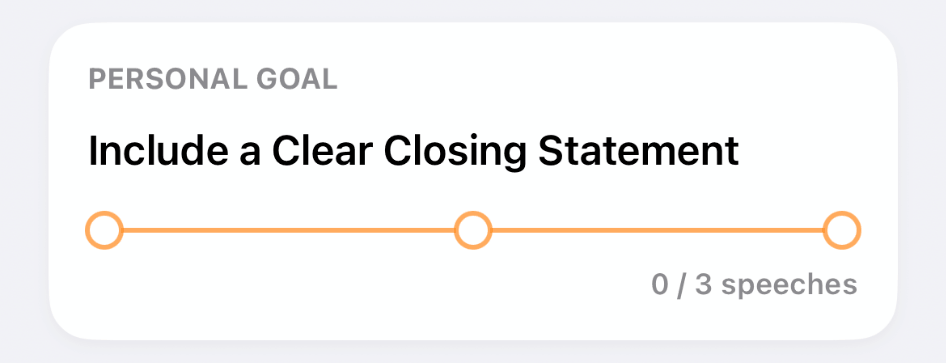
Each goal explains why it was chosen, shows exactly how to complete it, and includes a practical speaking tip. Instead of broadly asking you to “improve your content,” it gives you a focused action you can remember while speaking. For example, if you repeatedly end abruptly, your goal may be to finish three speeches with a clear conclusion.
You work on one personal goal at a time. When you demonstrate the correction in a speech, your progress moves forward. Repeating it across several speeches shows that the change is becoming a reliable speaking habit.
A plan that adapts as you improve
A goal is completed after you demonstrate its correction in the required number of speeches. Your progress stays visible in the Practice tab, and completed goals remain in your profile so you can look back at the skills you have strengthened.
Once a goal is complete, Babli can choose a new focus based on your more recent speeches. If a corrected habit begins appearing regularly again, it can return as a future goal rather than being treated as permanently solved.
Over time, this creates continuity between your practice sessions. Instead of only collecting individual scores, you repeatedly apply useful corrections until they become more natural speaking habits, while your completed goals provide a record of your long-term progress.
A specific improvement goal does not need to be assigned after every speech. If no meaningful pattern has surfaced yet, Babli enters a short calibration period and may ask you to give a few more speeches across different situations. This gives it enough context to choose a useful goal instead of assigning vague advice too early.
Use personal goals across the whole app
Personal goals work alongside Babli's structured public speaking courses, a fresh Speech of the Day, and custom practice. Most goals can be completed in any practice mode, so you can continue with the situations that matter to you. When context is important, a goal can be more specific, such as using a concrete example in three interview speeches.
Your first goal can also reflect why you want to improve, such as preparing for an interview or giving better presentations at work. As you continue practising, future goals become more closely connected to the habits Babli observes in your speeches.