

5 Steps to Overcome Public Speaking Anxiety and Speak with Confidence


Public speaking anxiety is one of the most common fears people face. The difference between anxious speakers and confident ones is not the absence of nerves but the ability to manage them. Confidence comes from training your body and mind to respond differently when you step in front of an audience.
This guide breaks down five proven steps you can follow. Each step combines psychology, practical exercises, and exposure so that you can reduce anxiety and deliver your message with clarity.
Step 1: Reframe Preparation
Many people prepare in ways that make anxiety worse. Memorizing word-for-word scripts sets you up to panic if you forget a single line. Good preparation is not about perfection. It is about familiarity.
Break your speech into three key points.
Use keywords or bullet points as anchors, not full sentences.
Polish only your opening and closing lines so you always know how to start and finish.
If you want to sharpen your ending, see How to End a Speech So People Remember It.
Step 2: Use Exposure, Not Just Rehearsal
Reading your speech silently or running through it once or twice at home does little to reduce anxiety. What works is exposure. The more often you place yourself in the speaking situation, the more your body learns that it is safe.
Psychologists use exposure therapy to treat phobias, and it works for public speaking too. Each time you face the stress of being watched, the fight-or-flight response weakens.
Here is how to apply it:
At-home drills: Start with the exercises in How to Practice Public Speaking at Home: 5 Simple Exercises That Work.
Raise the stakes: Add one or two people as your audience. Notice your nerves spike, then fade as you continue.
Simulate the real thing: The hardest part to recreate is the feeling of eyes on you. That pressure is what makes real speaking feel different.
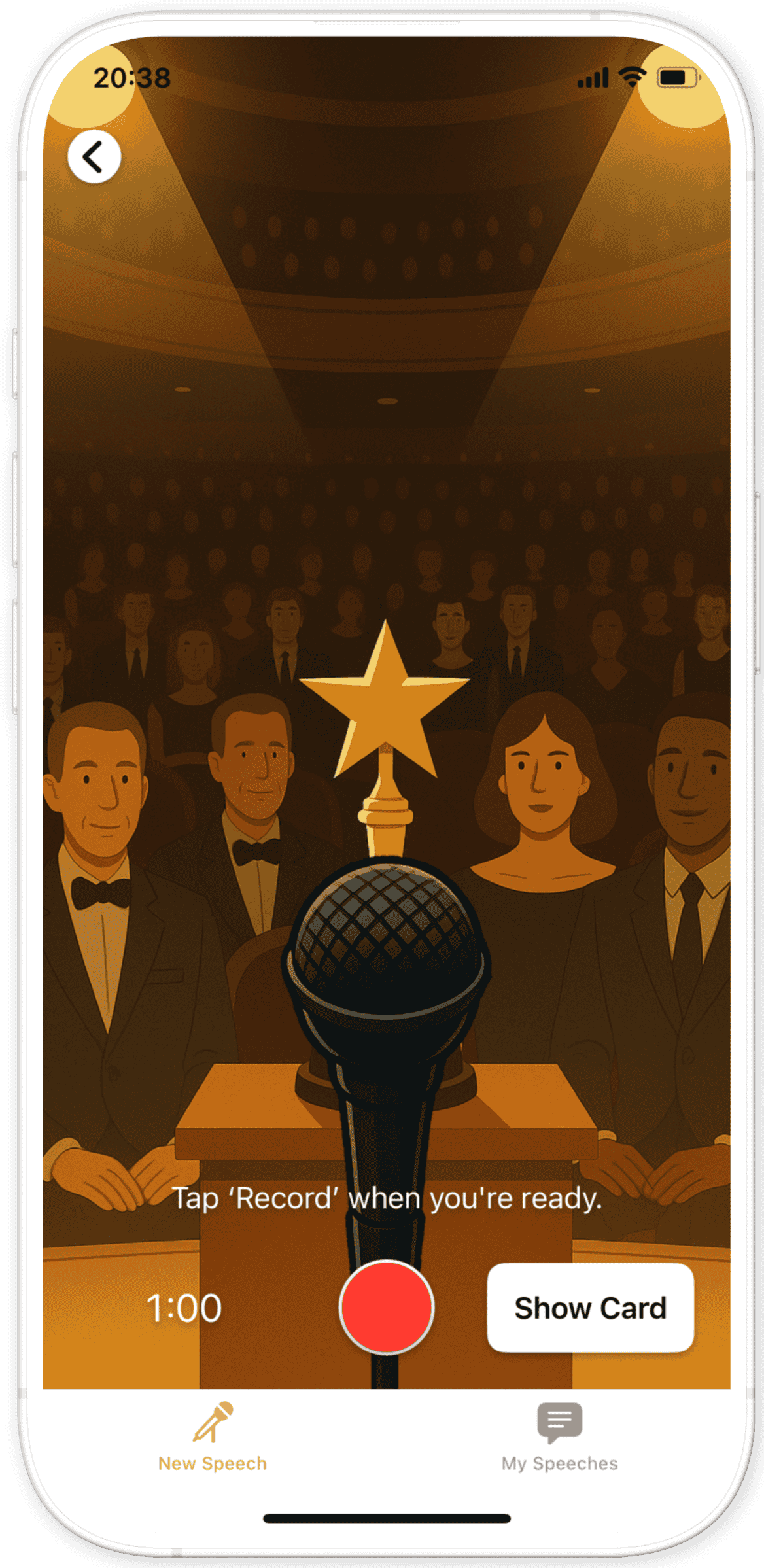
Babli was designed for this. It creates lifelike practice environments where you face a virtual audience, experience silences between your sentences, and receive feedback. By training in these conditions, your nervous system adapts so that when you face a real audience, the stress response is already lower.
Step 3: Train Your Physiology
Even with preparation and exposure, nerves can still show up. The key is learning how to calm your body quickly so you stay in control.
Box breathing: Inhale for 4 seconds, hold for 4, exhale for 4, hold for 4. Repeat three times.
Progressive relaxation: Tense and release your shoulders, fists, or jaw to release hidden tension.
Grounding: Focus on contact points such as feet on the floor or hands on a lectern to anchor yourself.
These techniques signal safety to your brain and slow down the release of adrenaline.
Step 4: Own the First 60 Seconds
The opening of a speech feels hardest because adrenaline peaks just before you begin. Once you are into your talk, your body usually starts to settle.
To make the start easier:
Memorize your first two sentences so you begin without hesitation.
Make eye contact with one or two friendly faces.
Pause before speaking. A short silence creates authority and helps you ground yourself.
If you control the opening minute, momentum will carry you through the rest.
Step 5: Shift From Self to Service
Anxiety grows when your thoughts are inward: How do I sound? What if I forget something? Confidence grows when your focus shifts outward: What do they need to hear?
Think of your talk as a message that will help your audience.
Replace self-judgment with audience awareness.
Treat your delivery as a conversation, not a performance.
This mindset shift reduces self-consciousness and builds connection.
Key Takeaway
Public speaking anxiety is natural, but it does not have to control you. By reframing preparation, using exposure, calming your body, mastering the first 60 seconds, and focusing on your audience, you can retrain your system to stay calm.
Babli makes this process faster. Instead of waiting for rare speaking opportunities, you can simulate them as often as you like. By practicing in lifelike environments, your body learns to handle the pressure of being watched. Over time, the stress response fades, and confidence takes its place.
Nerves may never disappear entirely, but with the right kind of practice, they become manageable. Eventually, they become the energy that powers a strong and memorable performance.
You should also read:

How to Speak on Virtual Calls: 5 Tips for Confident Zoom Presentations
Virtual calls are now a standard part of professional life. Whether you are leading a meeting, interviewing, or pitching to clients, how you speak on screen directly shapes how people see your confidence and credibility. The challenge is that virtual speaking is different from being…
Continue reading...
How to Speak Like a Leader: 5 Communication Habits That Inspire Confidence
Leaders are remembered not just for the decisions they make but for how they communicate them. The ability to speak clearly, confidently, and with authority is what turns ideas into action and teams into movements. Speaking like a leader does not mean copying someone else’s…
Continue reading...
How to Practice Public Speaking at Home: 5 Simple Exercises That Work
Public speaking is one of those skills that almost everyone wants to improve, but few people get the chance to practice regularly. You might have a big presentation coming up, a wedding toast to deliver, or just a desire to feel more confident when speaking…
Continue reading...